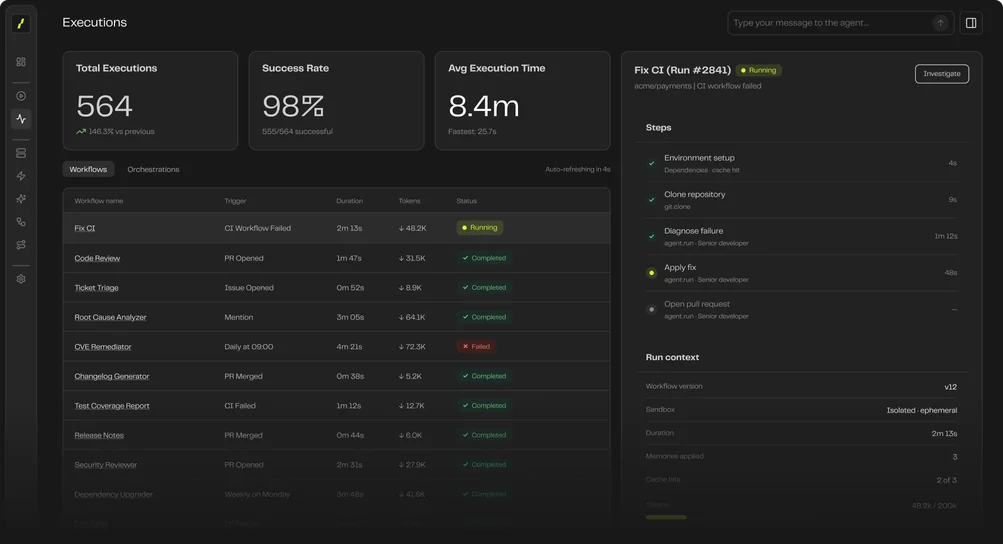


Built as a production system for agentic SDLC automation

Stop building agentic chaos on top of CI. Overcut provides a structured control plane for long-lived, stateful, and governed SDLC workflows.

Long-Running and Stateful Workflows

Most SDLC processes are not single commands. They involve waiting for reviews, approvals, retries, and external signals. Overcut natively supports long-running workflows with durable state, allowing agents to pause, resume, and continue execution without losing context.

Value to teams
  • Automate real processes, not just scripts
  • Handle human-in-the-loop steps cleanly
  • Avoid brittle retry logic and timeouts

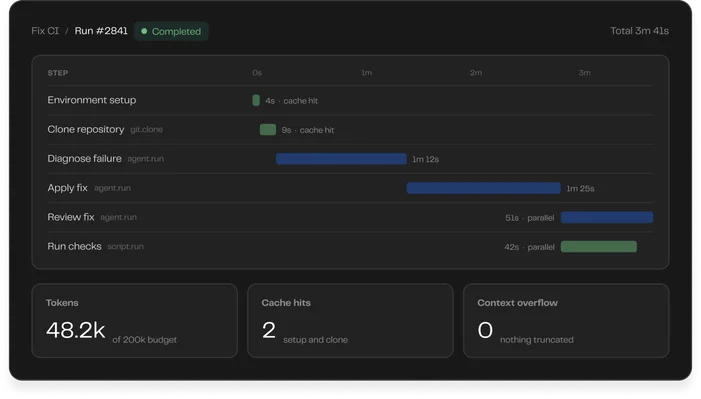
Token Management and Execution Control

Overcut manages token usage across agents and workflow steps to prevent runaway costs and failures. Includes token budgeting per workflow/execution, controlled context growth, and safe retries.

Value to teams
  • Predictable costs
  • Stable execution under load
  • No silent failures due to context overflow

Native Git and Ticket Integrations

Overcut integrates deeply with GitHub, GitLab, Azure DevOps, Jira, Linear, and ClickUp. Workflows are triggered by real events (PRs, commits, comments) and write results back into the same systems teams already trust.

Value to teams
  • No duplicate systems
  • No manual syncing
  • Automation lives where work already happens

Custom Agents and Role-Based Execution

Overcut allows teams to define custom agents with clear responsibilities such as reviewer, analyst, planner, or implementer. Each agent operates with scoped permissions, defined tools, and clear input/output expectations.

Value to teams
  • Higher quality outcomes
  • Easier reasoning and debugging
  • Clear separation of responsibilities

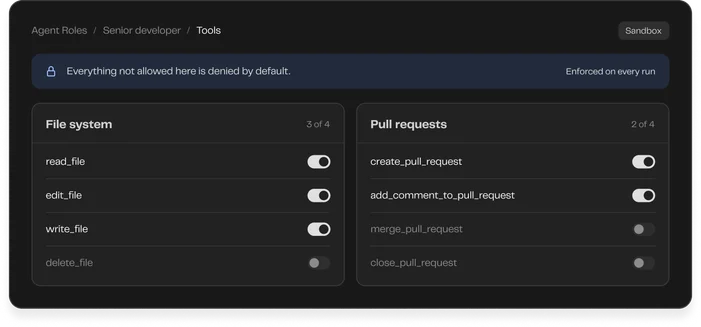
Tool Governance and Permissions

Agents only have access to explicitly allowed tools such as Git operations, file system access, package managers, or external APIs. Tool access is controlled at the workflow and agent level.

Value to teams
  • Reduced blast radius
  • Safer automation
  • Alignment with security policies

Sandbox Execution Environments

Each workflow executes inside a secured sandboxed environment, isolated from other runs and tenants, with controlled CPU/memory limits and isolated file systems.

Value to teams
  • No cross-run interference
  • Safer code execution
  • Predictable resource usage

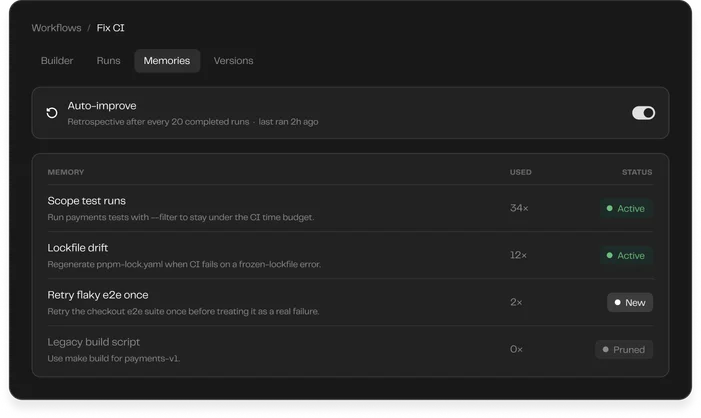
Agent Memories

Overcut agents create and use memories on the fly as they work across workflows and repositories. Learned patterns, conventions, past decisions, and domain-specific knowledge are captured during execution and recalled in future runs, allowing agents to improve continuously without manual configuration.

Value to teams
  • Agents learn from every execution
  • No repeated mistakes across runs
  • Domain knowledge accumulates automatically

Reflections and Self-Improvement

Overcut periodically reflects on completed workflow runs through retrospectives. Each retrospective investigates what happened, promotes observations that recur into confirmed guidance, reweights memories based on real impact, and prunes guidance that stopped being useful. Workflows get sharper automatically as they accumulate runs.

Value to teams
  • Workflows improve without manual tuning
  • Harmful or stale guidance is pruned automatically
  • Run a focused review on any single run on demand

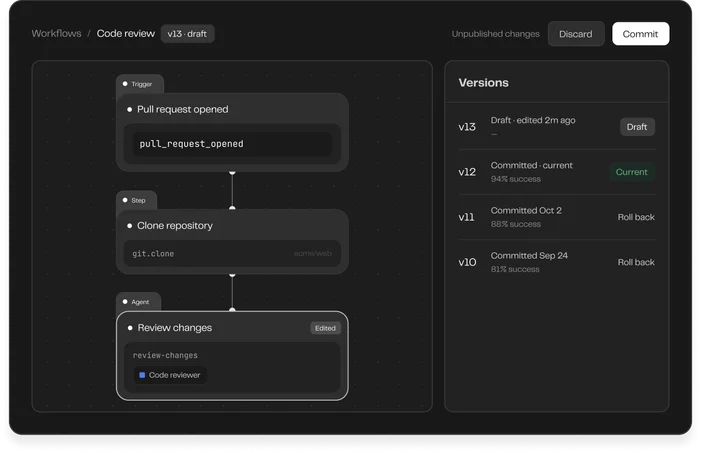
Workflow Versioning

Every workflow is versioned, allowing teams to track changes, compare execution outcomes across versions, and measure quality improvements over time. Version history provides a clear audit trail of how automation evolves and enables controlled rollouts of workflow updates.

Value to teams
  • Measure quality improvements over time
  • Safe rollbacks when needed
  • Data-driven workflow optimization

Dependency Installation and Environment Setup

Overcut supports installing dependencies, building projects, running tests, and executing tooling as part of workflows. Supports language-specific environments and dependency caching.

Value to teams
  • Works on real repositories
  • No manual preparation
  • Faster execution through reuse

Caching and Reuse

Overcut caches artifacts such as dependencies, indexes, and intermediate results across workflow runs to reduce execution time and cost.

Value to teams
  • Faster workflows
  • Lower compute and token usage
  • Better scalability

Triggers and Event-Driven Automation

Workflows can be triggered by PR creation/updates, Jira or ClickUp ticket changes, labels, comments, or schedules. Triggers are declarative and auditable.

Value to teams
  • Automation happens at the right time
  • No polling or brittle glue code
  • Clear operational behavior

Semantic Search and Code Indexing

Overcut builds and maintains semantic indexes of repositories, enabling agents to search and reason about code beyond keyword matching. Includes code structure awareness and dependency relationships.

Value to teams
  • Higher quality analysis
  • Better root cause identification
  • More accurate code changes

Observability and Audit Trail

Every workflow run is observable from trigger to outcome. Includes step-level logs, inputs/outputs, decisions, approvals, and external system actions.

Value to teams
  • Debug automation confidently
  • Meet compliance requirements
  • Continuously improve workflows

Deployment Flexibility

Overcut supports multiple deployment models: Fully managed SaaS, Private cloud or VPC, On-prem environments, and BYOK LLM and model control.

Value to teams
  • Meet security and compliance needs
  • Avoid vendor lock-in
  • Align with internal infrastructure standards

Native Git and Ticket Interface

Overcut operates directly inside Git, Jira, Linear, and ClickUp using native primitives such as comments, labels, statuses, and assignments. Agent activity, decisions, and progress are visible where teams already work, allowing entire agent teams to be orchestrated directly from Jira, Linear, and ClickUp tickets and pull requests.

Value to teams
  • No new UI to learn
  • Work stays fully transparent
  • Agents operate as first-class participants

Ticket-to-Git Mapping at Scale

Overcut maintains explicit mappings between Jira, Linear, and ClickUp tickets and Git repositories, even in large organizations with many projects and hundreds of repos. Agents automatically identify the correct codebase, ownership, and dependencies for each ticket.

Value to teams
  • Works in complex org structures
  • Eliminates manual repo discovery
  • Accurate context for every task

Hierarchical Context Management

Overcut manages context at multiple levels including organization, project, repository, use case, workflow, and agent. Each level contributes scoped knowledge, policies, and constraints to ensure consistent and accurate execution.

Value to teams
  • Correct context without overload
  • Consistent behavior across runs
  • Fine-grained control over agent reasoning

Scheduled and Continuous Execution

Workflows can run on schedules such as nightly, weekly, or before standups. Overcut enables agents to work continuously to clean backlogs, prepare summaries, detect issues, and keep systems moving even outside working hours.

Value to teams
  • True 24/7 execution
  • Reduced backlog accumulation
  • Better prepared daily rituals

Locking, Prioritization, and Execution Control

Overcut enforces locking and priority rules to prevent conflicting agent actions. Workflows respect resource locks, ticket ownership, and execution priorities to ensure coordinated and predictable automation.

Value to teams
  • No agent collisions
  • Predictable outcomes
  • Organized and intentional automation

Organization-Level Token Management

Token usage is governed at the organization level with shared budgets, limits, and policies across all workflows and built-in integrations. This ensures consistent cost control across Jira, Linear, ClickUp, Git, and other connected systems.

Value to teams
  • Centralized cost governance
  • Fair usage across teams
  • No surprise overages

Visual Workflow Designer

Overcut provides a visual workflow designer for building, understanding, and maintaining complex use cases. Teams can model triggers, agents, decision points, and human approvals without managing low-level orchestration logic.

Value to teams
  • Easier maintenance at scale
  • Clear mental model of execution
  • Faster iteration on complex workflows

Built for real SDLC operations

Overcut is designed for the workflows that actually break at scale: long-running processes, cross-system coordination, human approvals, and evolving standards. It provides the structure, control, and observability required to operate AI-driven automation safely inside production engineering environments.
Get a Demo

Overcut transformed our ad-hoc code reviews into a standardized, CI/CD-driven workflow. Its AI reviewer quietly adds an extra set of expert eyes to every pull request, boosting code quality and freeing our engineers to focus on new features.

Yonatan SchreiberCEO · Blings.io

Connecting Jira with multiple Git providers and running workflows across them used to be fragmented and manual… now everything runs end-to-end in a single flow with the right context.

ChrisHead of Platform Engineering · Global software company

Automate. accelerate. Grow.