Agentic Orchestration
A single agent doing one task does not need orchestration. The moment a team runs many agents and workflows across many services, something has to decide what runs, when, and in what order, without a person clicking between tools. That coordination is agentic orchestration. It is the difference between a pile of capable agents and a system that delivers work across the lifecycle.
Overview
Orchestration is the layer of coordination above individual workflows. Where a workflow automates one task end to end, orchestration governs how many of those workflows and the agents inside them fit together: which one starts, what it depends on, how its output reaches the next, and where a human needs to weigh in. The industry usually pictures this as a central orchestrator, a manager agent or engine that calls workers and sequences every step.
There is a different model that scales better for software delivery. Rather than one engine that owns the whole lifecycle as a single state machine, orchestration can run as many small workflows that each own one concern and react to events. No master controller decides what happens next, because each workflow already knows what it is responsible for and what conditions cause it to run. This is the same shift application architecture made from monoliths to microservices, applied to the lifecycle: local ownership, parallel execution, and fault isolation, with the coordination carried by events rather than a shared pipeline. The coordination still has a home. It lives in the control plane, which holds the policies, permissions, and state that orchestration runs against.
How it works
Agentic orchestration coordinates many agents and workflows without forcing them through one global sequence. Four properties make it work:
Many workflows, each one concern
Instead of one engine that knows the whole lifecycle, orchestration runs many small workflows that each own a single job: triage a ticket, review a PR, fix a failing build, remediate a CVE. Each one is independent and replaceable.
Coordinated through events
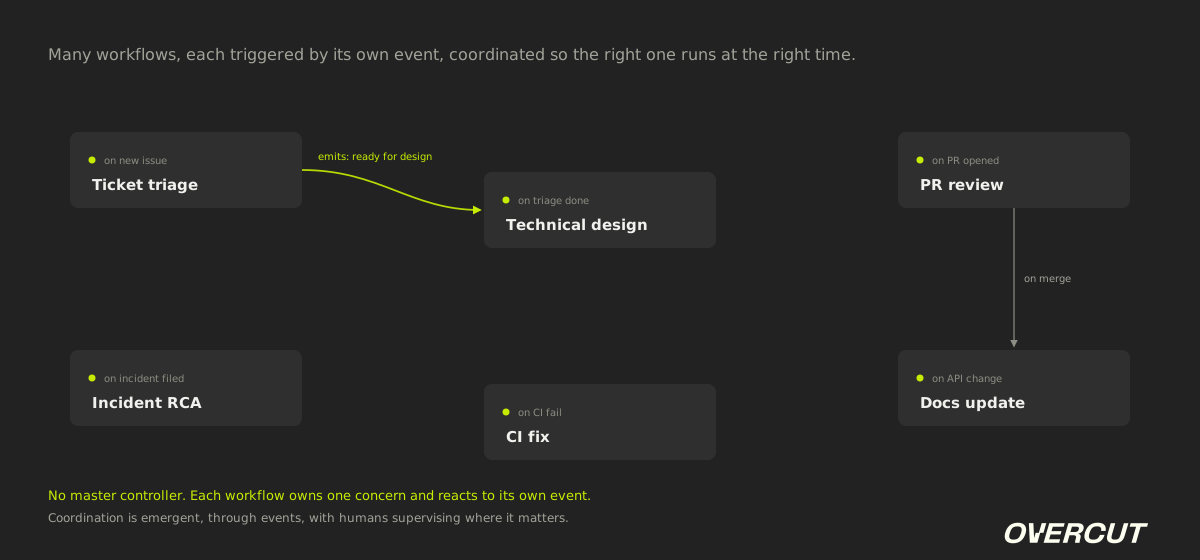
Workflows do not call each other directly. One emits an event, like "this ticket is ready for design," and any workflow whose conditions match picks it up. Coordination is emergent rather than dictated by a central controller.
Parallel and resilient
Because no global lock sits between an agent and the work, triage, a security review, and a docs update can run at once on the same codebase. If one workflow fails, the others keep moving instead of stalling a shared pipeline.
Humans supervise the flow
People do not operate each step. They set the policies, decide which points need approval, and review outcomes, so coordination scales across many agents without losing human control.
Example in practice
A new bug report lands and a triage workflow classifies it, sets severity, and decides it needs a design before implementation. It does not hand the ticket to a design workflow directly. It emits an event saying the ticket is ready for design, and the design workflow picks it up on its own. Meanwhile, unrelated work keeps moving: a CI-fix workflow is repairing a failing build on another branch, and a documentation workflow is updating a changed API reference. None of these waits on the others. When the design is approved at a human gate, that approval becomes the event that lets implementation begin. The organization runs many flows at once, coordinated by events, with people supervising the points that carry risk.
What is Agentic Orchestration?
Agentic orchestration is the coordination of multiple agents and workflows so the right work runs at the right time across the software lifecycle, with humans supervising where it matters.
Comparison: Agentic orchestration vs. the Single agentic workflow
A single workflow automates one task; orchestration coordinates many of them across the organization, and it replaces the manual coordination a developer used to do by hand.
Orchestrate agents across your SDLC
Overcut coordinates many workflows where work already happens, triggered by real events and supervised by humans, so autonomy scales without a brittle central pipeline.
Get a demoRelated content
By Overcut· 1 min read
Overcut named in the 2026 Gartner® Innovation Insight: AI Software Factories report
By Yuval Hazaz· 15 min read
Context Engineering: The Discipline Behind Reliable AI Agents
By Yuval Hazaz· 10 min read