
Control Plane
When one or two AI agents run inside a single repo, a developer can supervise them by hand. Once dozens of agents work across many services, that hands-on control does not scale, and the question becomes where the coordination lives. The control plane is that place: the single layer that decides which agent runs, what it is permitted to touch, and when its work can move forward. It is the part of an agentic system that stays in charge while the agents do the work.
Overview
The term comes from networking. A router splits into a data plane that forwards packets at speed and a control plane that decides the routes those packets follow. Cloud platforms generalized the split. In Kubernetes, the control plane (the API server, scheduler, controllers, and the etcd store) makes global decisions about the cluster and reconciles its desired state, while the workloads themselves run in the data plane. AWS draws the same line: control planes handle the administrative create, read, update, and delete operations, and data planes deliver the service's primary function.
Agentic systems borrow the same separation. Each agent runs tasks and calls tools in the data plane. The control plane sits above them and sets how they are deployed, how they coordinate, and the rules that bound their behavior. It exists for the same reason it did in networking: the work and the decisions about the work have different requirements. Agents need room to act, while the organization needs consistent policy, scoped permissions, and a record of what happened. Keeping those concerns in one coordination layer is what lets a team grant autonomy without losing control.
How it works
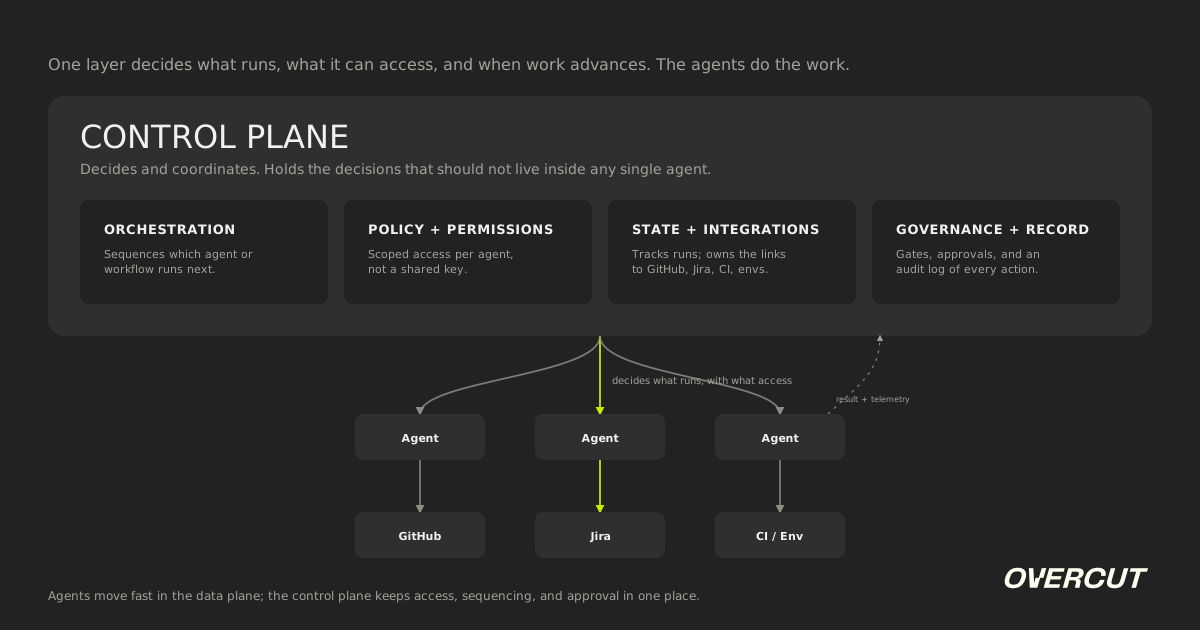
A control plane carries the decisions that should not live inside any single agent. Four responsibilities tend to sit there:
Orchestration
Coordinates which agent or workflow runs next and in what order, sequencing work across planning, implementation, review, and deploy.
Policy and permissions
Holds each agent's identity and scoped access, so a tool or repository is reachable only when policy allows it, not through a shared key.
State and integrations
Tracks workflow state across long-running runs and owns the connections to GitHub, Jira, CI, and target environments.
Governance and record
Applies governance gates and human approvals at set checkpoints, and logs every action against the request that triggered it.
Example in practice
A platform team needs the same dependency upgrade applied across forty services, so they assign the job to an agentic workflow. The control plane decides the order the repos are handled, gives each agent a short-lived token scoped to only the one repository it is working on, and tracks which services are done, in progress, or failed. When an agent finishes a change, the control plane checks the policy for that repo: low-risk services merge once CI passes, but the two services that touch billing hit a governance gate that routes the pull request to a human. No agent makes that routing decision on its own. The control plane does.
What is Control Plane?
A control plane is the coordination layer that decides what agents do, what they are allowed to access, and when their work advances. It holds the orchestration, policies, permissions, environments, workflow state, and integrations for an agentic system, separate from the agents that carry out the work.
Comparison: Control plane vs. the Data plane
The split is what makes agent autonomy safe to scale: agents move fast in the data plane, while the control plane keeps the decisions about access, sequencing, and approval in one consistent place.
Put a control plane over your SDLC agents
Overcut coordinates agents, policies, and approvals across your repos, so autonomy scales with control built in.
Get a demoRelated content

By Overcut· 1 min read
Overcut named in the 2026 Gartner® Innovation Insight: AI Software Factories report
By Yuval Hazaz· 15 min read
Context Engineering: The Discipline Behind Reliable AI Agents

By Yuval Hazaz· 10 min read