Guardrails
Handing real work to an autonomous agent only makes sense if you can bound what it is able to reach. Guardrails are how you draw that line. They are the limits an organization sets around an agent before it does anything: which tools it can use, which systems and data it can touch, and what its inputs and outputs are allowed to contain. Set the box well and an agent can move fast inside it without ever putting the things outside it at risk.
Overview
As agents take on more of the software lifecycle, "what is this agent allowed to reach?" becomes a design decision, not an afterthought. A capable agent with broad access is a broad risk; the same agent with a tight, deliberate boundary is a safe one. Guardrails are where that boundary is drawn. They are preventative by nature: they set the limits up front, so the agent works inside them from its first action instead of being corrected after the fact, the way monitoring or an audit trail records what already happened.
Guardrails come in two families. Action and scope guardrails bound what the agent can do in the world: the tools it may call, the repositories and systems it may touch, and the data it may read, usually through scoped permissions and least-privilege identity. Content guardrails bound what flows through the model: filtering unsafe or malformed inputs and screening outputs for leaked data. Drawing the box is one job; holding the agent to it on every action is another, which is the role of policy enforcement. In Overcut, the scoped access behind these boundaries is held in the control plane, so the same limits apply to every agent and repository instead of being set by hand per task.
How it works
A guardrail is a boundary the agent operates inside, defined before it acts and applied to every action. Four properties make them work:
Set before the agent acts
Guardrails are preventative, not reactive. They define the limits up front, as standing boundaries, rather than catching a problem in a report afterward. The agent operates inside the box from its first action.
Action and scope boundaries
Limits on the tools an agent may call, the systems and repositories it may touch, the actions it may take, and the data it may read. Expressed as scoped permissions, tool scopes, and least-privilege identity, so an agent cannot reach beyond its task.
Content boundaries
Checks wrapped around the model's inputs and outputs: filtering unsafe or malformed prompts and tool results, catching prompt-injection attempts, and screening responses for leaked secrets or data that should not leave.
Boundaries, not the engine
Guardrails describe what is in and out of bounds. A separate mechanism, policy enforcement, holds the agent to them on every action. Defining the box and policing it are two different jobs.
Example in practice
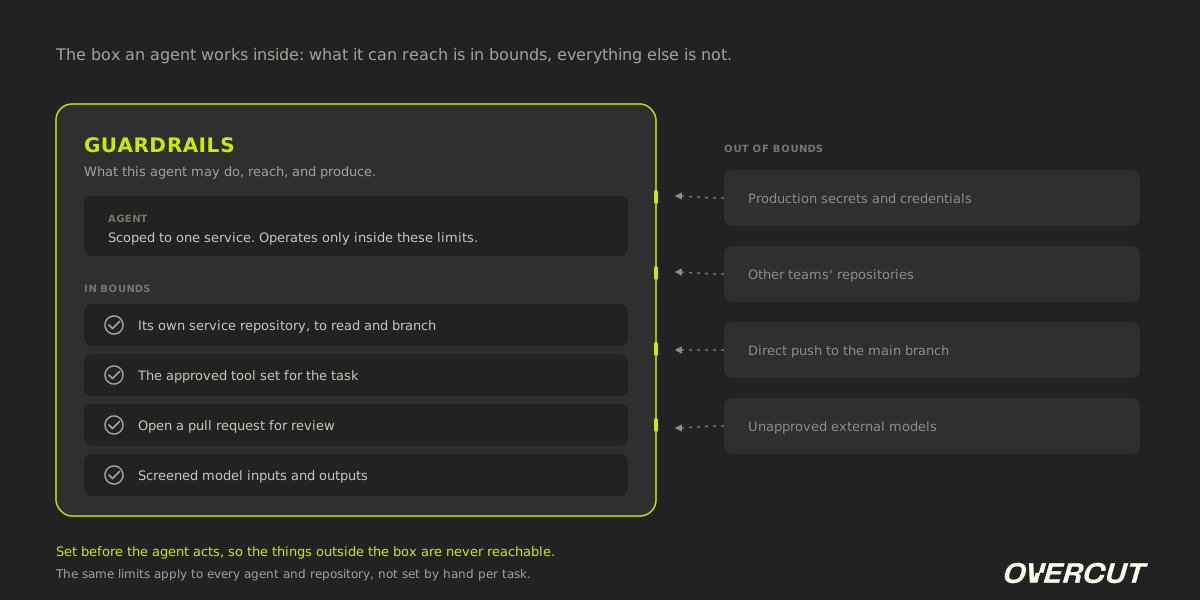
A team gives an agent the job of upgrading a dependency in one service. The agent's identity is scoped to that single repository, with read access to its code and permission to open a pull request, and nothing else. When the agent resolves the change, it has no credential that reaches production, no path to another team's repository, and no ability to push directly to the main branch. Its content guardrails also screen the diff so a hardcoded secret never lands in the commit. Even if the agent produced a flawed plan, the boundary holds: the blast radius is the one service it was scoped to, because the things outside the box were never reachable in the first place.
What is Guardrails?
Guardrails are the predefined boundaries that constrain what an AI agent can do, access, or change, set before the agent acts so its autonomy stays inside limits the organization chooses.
Comparison: Guardrails vs. the Policy enforcement
The three work together: guardrails define the box an agent operates in, policy enforcement keeps it in that box on every action, and governance gates decide when its work may cross into the next stage.
Give every agent a box it cannot leave
Overcut runs agents inside the guardrails you set, scoped access, allowed tools, and content limits, so autonomy never reaches beyond the task in front of it.
Get a demoRelated content

By Overcut· 1 min read
Overcut named in the 2026 Gartner® Innovation Insight: AI Software Factories report
By Yuval Hazaz· 15 min read
Context Engineering: The Discipline Behind Reliable AI Agents
By Yuval Hazaz· 10 min read