
Policy Enforcement
It is one thing to write down the rules an AI agent should follow. It is another to make sure it actually follows them on every action, across every repository, without a person checking by hand. Policy enforcement is the part of an agentic system that closes that gap. It turns standards from a document people are supposed to remember into rules a machine applies automatically, allowing the work that fits policy and blocking the work that does not.
Overview
As agents take on more of the lifecycle, the rules they operate under cannot stay informal. A policy that says "agents may not pull in dependencies with non-approved licenses" or "no customer data leaves an approved model" only matters if something checks it every time. That is the job of policy enforcement: the engine that sits between an agent and the action it is trying to take, and decides whether the action is allowed.
The mechanism is borrowed from access control. A decision point evaluates a request against the defined policies and returns permit or deny. An enforcement point, sitting in the path of the action, carries out that decision in real time, letting the action proceed or stopping it. This is what separates enforcement from the rules themselves. The guardrails define what is in and out of bounds; policy enforcement is the runtime machinery that holds an agent to them on every action. In Overcut, this machinery lives in the control plane and runs against the standards you define, so the same policies apply consistently to every agent and every repo instead of being re-litigated per task.
How it works
Policy enforcement makes rules binding by evaluating each action and acting on the result. Four properties make it work:
Policy as code
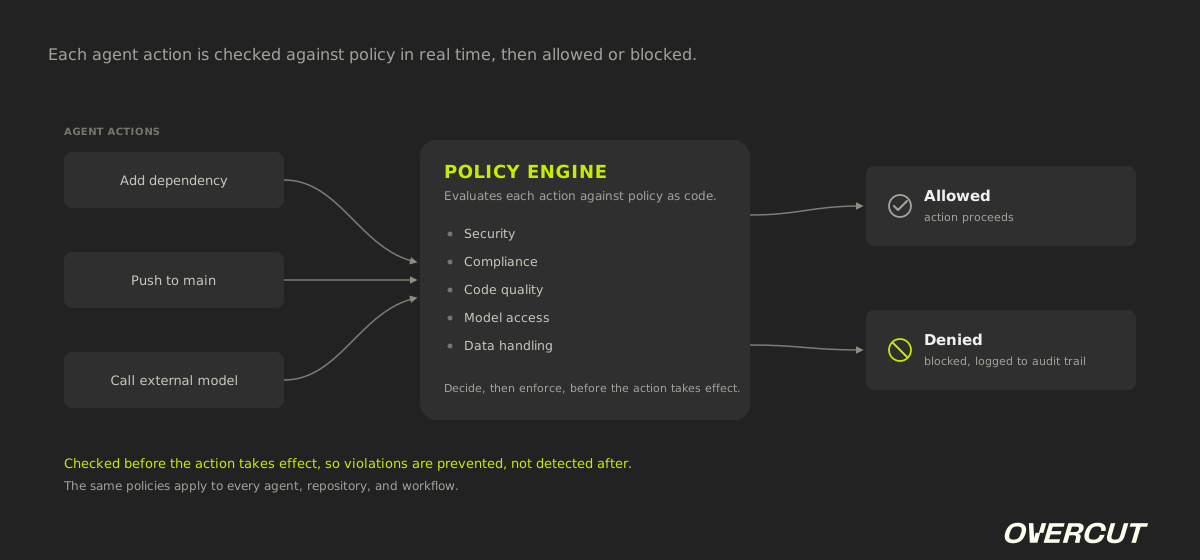
The rules an agent must follow, for security, compliance, code quality, model access, and data handling, are written in a machine-readable form rather than a wiki page, so a system can apply them automatically and the same way every time.
Decide, then enforce
When an agent attempts an action, a decision point evaluates the request against policy and returns permit or deny. An enforcement point sits in the path of the action and carries out that result: it lets the action through or stops it.
Checked at execution time
Enforcement happens before the action takes effect, not in a report afterward. A disallowed change is blocked at the moment it is attempted, so violations are prevented instead of discovered later.
Consistent across the org
The same policies apply to every agent, repository, and workflow. Enforcement replaces uneven, manual review with one engine, which is what lets a team grant autonomy without each agent negotiating its own rules.
Example in practice
An agent is upgrading dependencies across a service. It resolves a transitive package and prepares to add it, but that package ships under a license the organization does not allow. Before the change is written, the action is evaluated against policy: the license check fails, so the enforcement point blocks it. The agent does not commit the package; instead it records the blocked attempt and looks for an approved alternative. No human had to catch the violation in review, because it never made it into the codebase. The same engine would have denied an attempt to reach a repository outside the agent's scope or to send source to an unapproved model provider.
What is Policy Enforcement?
Policy enforcement is the mechanism that checks each agent action against your rules and allows or blocks it at execution time, making standards for security, compliance, code quality, model access, and data handling binding rather than advisory.
Comparison: Policy enforcement vs. the Guardrails
The three work together: guardrails define the box an agent operates in, policy enforcement keeps it in that box on every action, and governance gates decide when its work may cross into the next stage.
Make your standards binding for every agent
Overcut enforces your policies for access, security, and quality at runtime, across every repo and workflow, so autonomy never runs outside the rules you set.
Get a demoRelated content

By Overcut· 1 min read
Overcut named in the 2026 Gartner® Innovation Insight: AI Software Factories report

By Yuval Hazaz· 15 min read
Context Engineering: The Discipline Behind Reliable AI Agents

By Yuval Hazaz· 10 min read