Audit Trail
When a person ships a change, the paper trail comes for free: a commit author, a reviewer, a linked ticket, an approval in the PR. Hand that work to an autonomous agent and the implicit record disappears, right when you most want to know what moved and why. An audit trail puts it back on purpose. It is the record of every action an agent took, the context it acted on, and the authority it acted under, captured as the work happens so it can be reconstructed long after.
Overview
Guardrails, policy enforcement, and governance gates all act before or during an agent's work: they bound what it may do, hold it to the rules on every action, and decide when it may advance. The audit trail is the one piece that looks backward. It does not constrain the agent; it records it, so that when someone asks what happened weeks later, there is a defensible answer instead of a guess.
That retrospective role is why an audit trail is more than a log file. An autonomous agent acts with delegated privileges and a dynamic, branching execution path, which makes after-the-fact reconstruction hard unless the record was designed for it. The trail has to tie each action to an identity, an intent, and an authority, and it has to survive unchanged. In Overcut, this record lives in the control plane and spans every workflow and repository, so the history of agent activity is consistent across the organization rather than scattered across individual tools.
How it works
An audit trail captures each agent action as a structured entry and preserves the sequence of them. Four properties make it useful as evidence rather than noise:
Records the why, not just the what
An ordinary log captures what happened: an action, an error, a timestamp. An audit trail also captures the intent behind it: the prompt, the context the agent saw, and the reasoning that led to the action. That is what makes an autonomous decision reviewable after the fact.
Captures the full action chain
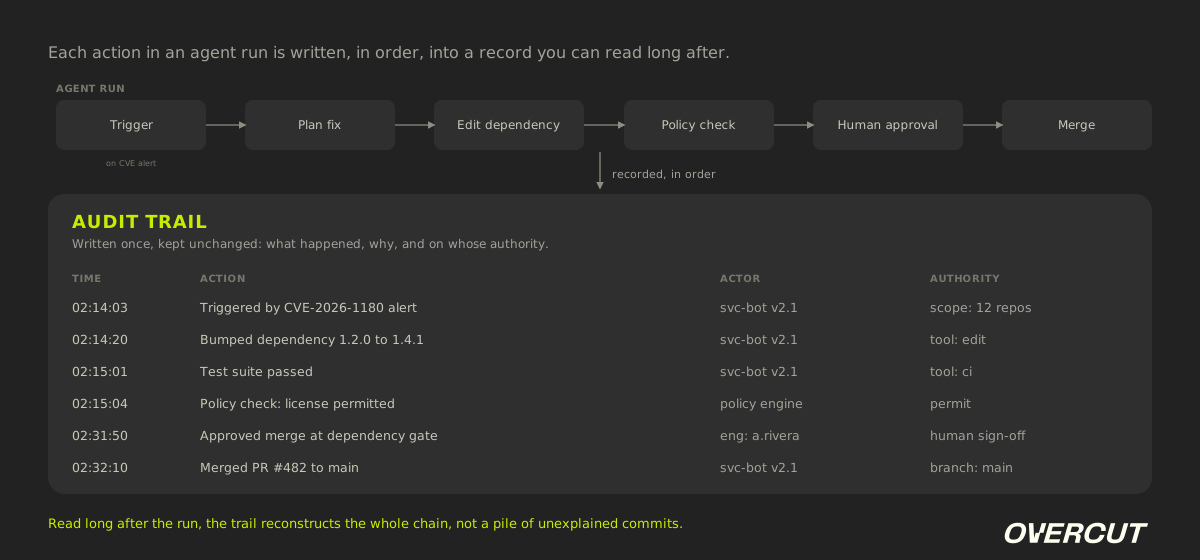
Each entry ties together the trigger that started the work, every tool call and its result, the data and repositories accessed, each policy decision to permit or deny, any human approvals, and the outputs produced. The trail is the sequence of those entries across a run.
Tied to identity and authority
Every entry records the agent's identity and version, the human or system that authorized the work, and the scope it was granted. An action is never anonymous, so accountability does not disappear when an agent does the work instead of a person.
Tamper-evident and retained
Unlike a debug log that rolls over, audit entries are written once and protected from change, then kept for a defined retention period. That is what lets the trail stand as evidence in a security review or compliance audit rather than as a best-effort record.
Example in practice
A critical CVE lands in a shared dependency, and an agent is assigned to remediate it across twelve services overnight. For each repository it bumps the version, runs the test suite, opens a pull request, and stops at a governance gate where an on-call engineer approves the change before merge. A month later, a security review asks a simple question: who changed this dependency, in which services, and was it approved? Without an audit trail, the answer is twelve commits with no story behind them. With one, the review replays the whole chain: the CVE alert that triggered the work, the agent identity that did it, the policy checks that passed, the engineer who approved each gate, and the PRs that merged. The agent moved fast across a dozen repos, and the record of how it did so held.
What is Audit Trail?
An audit trail is the chronological, tamper-evident record of every action an agent takes, along with the context and reasoning behind it, so any agent-driven change can be traced back to what happened, why, and on whose authority.
Comparison: Audit trail vs. the Application logging
The three overlap in that all of them write records, but they answer different questions: application logs help you fix what broke, monitoring tells you how the system is behaving right now, and the audit trail tells you who did what, why, and on whose authority.
Make every agent action accountable
Overcut records what each agent did, why, and on whose approval, across every repo and workflow, so autonomy comes with a trail you can stand behind.
Get a demoRelated content

By Overcut· 1 min read
Overcut named in the 2026 Gartner® Innovation Insight: AI Software Factories report

By Yuval Hazaz· 15 min read
Context Engineering: The Discipline Behind Reliable AI Agents

By Yuval Hazaz· 10 min read