Human-in-the-Loop
When an agent can take an entire task from plan to merge in minutes, the question is no longer whether it can do the work but where a person should weigh in. Human-in-the-loop is the answer. It keeps people involved at the decisions that matter, so agents move fast on their own and a human still owns the calls that carry risk. The point is not to slow the agent down everywhere. It is to put human judgment exactly where it counts.
Overview
In a traditional workflow a person is in the loop almost by default, because they perform every step. Once an autonomous agent does the work, that implicit oversight disappears, and it has to be put back deliberately. Human-in-the-loop is how: defined points where the agent's work pauses for human judgment before it can advance. It is the principle; governance gates are the mechanism that holds the work until a person, or an automated check, signs off.
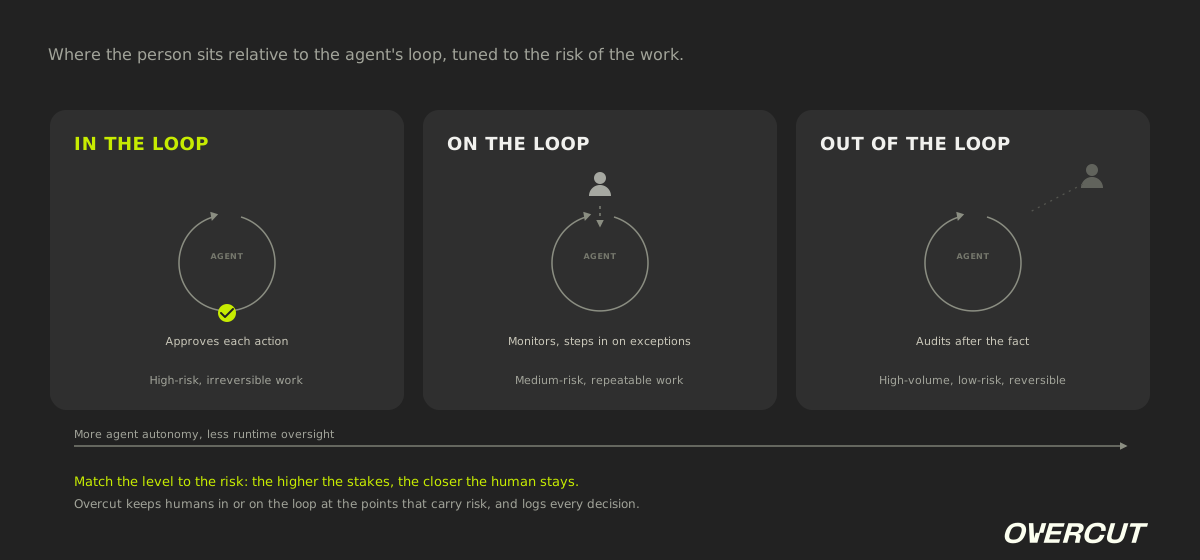
Keeping a human in the loop is not all-or-nothing. There is a spectrum. A person can be in the loop, approving each action before it happens; on the loop, letting the agent run while they monitor and step in on exceptions; or out of the loop, with oversight reduced to after-the-fact auditing. Each trades control for speed and scale. The governing rule is simple: the higher the risk and the harder it is to reverse, the closer the human should stay. In Overcut's model, this is what lets humans move up the stack. They stop operating every tool and start governing intent, deciding which points need sign-off and reviewing outcomes rather than raw data, while agents handle the work in between.
How it works
Human-in-the-loop puts people at the decisions that carry risk and lets agents run between them. Four properties make it work:
Participation at decision points
A human is not involved in every keystroke. They weigh in at the points that carry risk: approving a plan, a release, or a change that touches sensitive systems. The agent runs freely between those points.
The agent pauses and presents
When work reaches a decision point, it stops and waits. The agent surfaces its outcome and the context behind it, a diagnosis or a proposed change, so the person reviews a result rather than digging through raw data.
Humans move up the stack
Instead of operating each tool, people set the policies, decide what needs sign-off, and review outcomes. Their role shifts from executing steps to governing intent, direction, and acceptable risk.
Tuned to risk
How close the human stays depends on the stakes. High-risk, irreversible work keeps a person in the loop on every action; low-risk, reversible work can move to monitoring or after-the-fact review.
Example in practice
A failing build triggers a workflow. An agent reads the logs, finds the cause, writes the fix, runs the tests, and pushes the change to the pull request branch, all on its own. Then it stops. Merging to main is the decision that carries risk, so it is a human-in-the-loop gate: a person reviews the change and the agent's summary and approves the merge before anything ships. For a low-risk lint fix on a throwaway branch, the same team keeps a human on the loop instead, notified of the change with the ability to override, so it merges without waiting. The level of involvement matches the stakes, and either way the autonomy never runs past human judgment.
What is Human-in-the-Loop?
Human-in-the-loop is the operating model where a person participates at defined decision points so an AI agent advances work only with human judgment, keeping people in control while agents do the work.
Comparison: Human in the loop vs. the Human on the loop
The three are a spectrum, not a hierarchy. Most teams keep humans in the loop for risky, irreversible work and on the loop for routine work, moving the line as their confidence in a workflow grows.
Keep humans in control as agents scale
Overcut runs autonomous agents inside your guardrails and pauses for human approval at the points that carry risk, with a record of every decision.
Get a demoRelated content
By Overcut· 1 min read
Overcut named in the 2026 Gartner® Innovation Insight: AI Software Factories report
By Yuval Hazaz· 15 min read
Context Engineering: The Discipline Behind Reliable AI Agents

By Yuval Hazaz· 10 min read