Enterprise control by design
Balance autonomy with the guardrails your platform team sets. Every run is permissioned, sandboxed, verified, and written to an audit trail you can trace.
- RBAC & policies
- Sandboxed execution
- Full audit trail
- SSO & SCIM
- Data residency
Control at every layer
RBAC, roles & teams
Role-based access with custom roles and teams scopes every workflow, agent, repo, and secret down to least privilege.
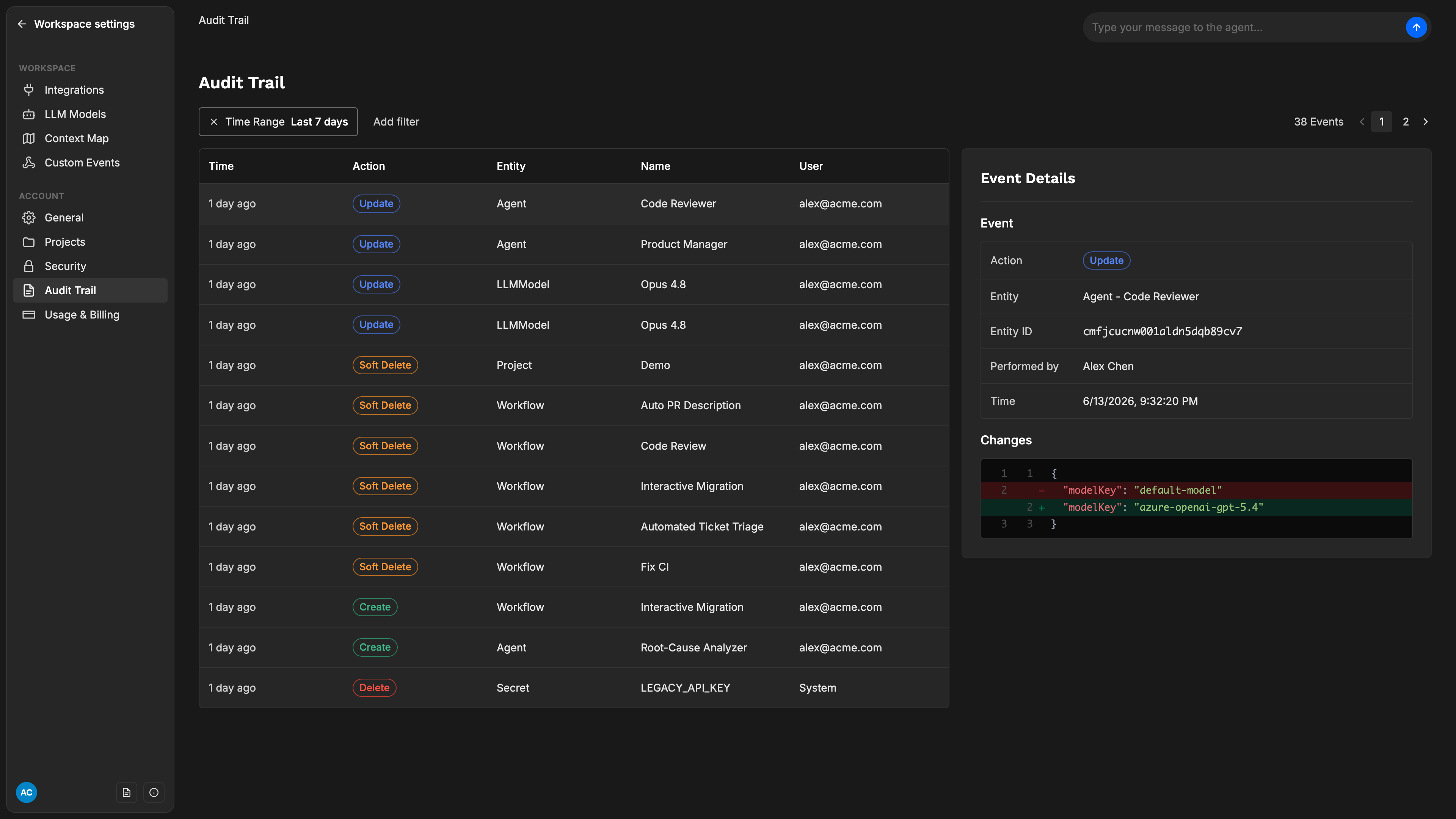
Immutable audit trail
An append-only record of every action, with before-and-after change tracking, queryable for debugging and compliance.
Encrypted in your perimeter
Secrets live in an encrypted vault and source code never leaves your environment, with encryption at rest throughout.
Enterprise SSO & directory
SAML and OIDC single sign-on with LDAP and Active Directory sync, so access maps to your identity provider.
Multi-team & multi-repo
Isolated workspaces, per-project teams, and monorepo-aware agents that coordinate changes across many repositories.
Model & token governance
Route across providers or bring your own models and keys, with shared budgets and limits that keep spend predictable.
Observe, measure, improve
Every workflow run is fully observable. See what each agent did, what it decided, and what it changed in your systems, then use that visibility to refine workflows over time.

Run it inside your perimeter
Managed in our cloud, in your own VPC, or fully on-prem, including air-gapped networks. Your code, logs, and outputs stay in your environment and under your ownership, never transmitted outside it.
Fully managed SaaS
Up and running in minutes. We run the control plane; you connect your tools and ship.
Private cloud / VPC
Deploy into your own cloud account so execution and data stay in your environment.
On-prem
Run entirely behind your firewall for the strictest data-residency requirements.
BYOK / BYOM
Bring your own model keys and route across providers or local models. You stay in control.
Outcomes you can trust
Autonomy is only useful if you can rely on the result. Overcut verifies agent work in layers, so nothing reaches your systems of record unchecked.
Deterministic validation
Tests, linters, and checks run on every change, with hard pass/fail gates.
LLM verification
A second model reviews the work against the task before it ships.
Human approval
Optional checkpoints put a person in the loop where it matters.
Full traceability
Every step, input, and decision is recorded and auditable.
Questions buyers ask
How can we deploy Overcut?
As fully managed SaaS, in your own private cloud or VPC, or fully on-prem on Kubernetes, including standalone and air-gapped installs. The same platform, controls, and integrations apply across all of them, so you can start in the cloud and move in-house later without re-learning the product.
Where do our code and data live?
In the deployment you choose. With private cloud and on-prem, code and agent activity never leave your environment, and on-prem can run on your own database, storage, and secrets. Managed SaaS runs single-region in the US, and every run executes in an isolated, ephemeral container that is destroyed when it finishes.
How do you handle security and access control?
Single sign-on over SAML and OIDC, with LDAP and Active Directory sync so access maps to your identity provider. Role-based access with custom roles and teams scopes every workflow, agent, repository, and secret to least privilege. Secrets live in an encrypted vault with encryption at rest, and are never exposed in logs.
What does the audit trail capture?
Every create, update, and delete across workflows, agents, roles, teams, secrets, and integrations, as an append-only, immutable record. Each entry tracks who acted, what changed before and after, and when, with sensitive values redacted. It is fully queryable for debugging and compliance.
Which models can we use, and can we bring our own?
Route across Anthropic, OpenAI, AWS Bedrock, Azure OpenAI, or local OSS models per workflow or per agent. Bring your own keys, or point Overcut at your own LLM gateway for a single budget.
How does Overcut support multiple teams and repositories?
Workspaces give each org or business unit a hard boundary, with per-project teams inside them. Agents are monorepo-aware and coordinate changes across many repositories, and org-wide workflows can run once per matching repo for fleet-wide maintenance.
How do we keep agents under control?
Each agent gets only the tools and repositories you approve, nothing more. Workflows define permissions, validations, and approval gates once, and they are enforced on every run. Results are verified in layers before anything is written back, and runs retry and resume safely after interruptions.