Disparate agents hit a wall.
Orchestrated ones break through it.
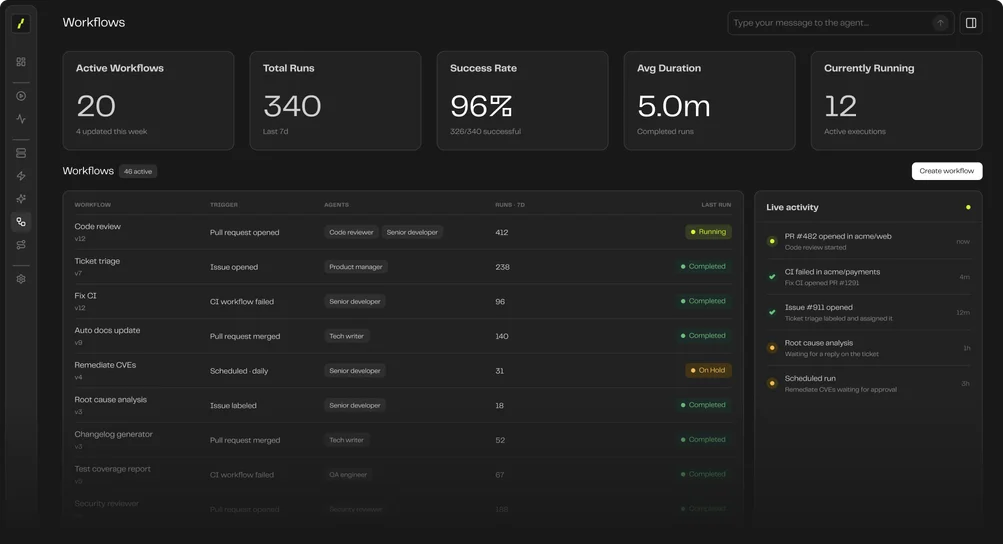
Point tools stall where the work crosses between them. Overcut orchestrates code review, testing, docs and more into one platform that keeps shipping.








One platform, not ten point tools
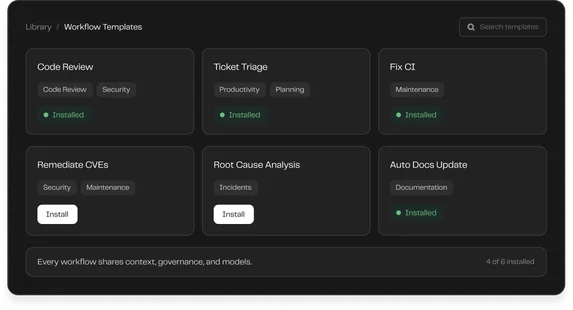
Code review, testing, docs, triage, CI fixes and CVEs run as workflows that share context, governance, and models.
Capabilities
- Code review
- Testing
- Doc updates
- Ticket triage
- CI fixes
- CVE remediation
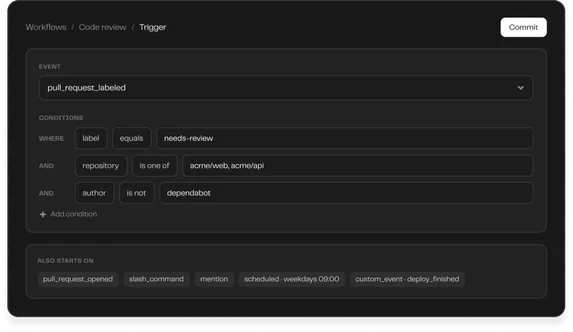
Triggers & events
PRs, ticket changes, labels, comments, or schedules start a run automatically.
Capabilities
- Pull requests
- Ticket changes
- Labels
- Comments
- Schedules
- Custom events
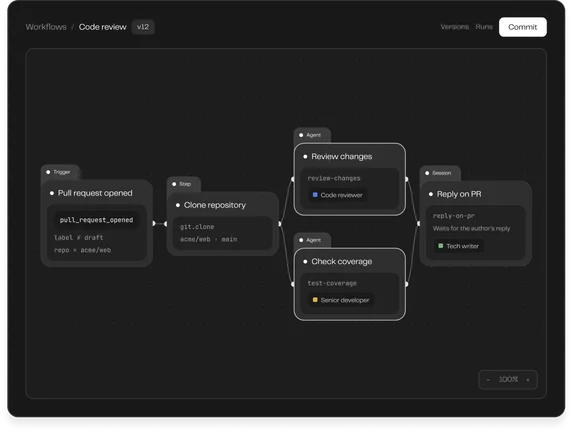
Parallel agents & approvals
Run specialized agents concurrently, gate on human checkpoints, and retry transient failures.
Capabilities
- Parallel agents
- Approvals & retries
- Locking & prioritization
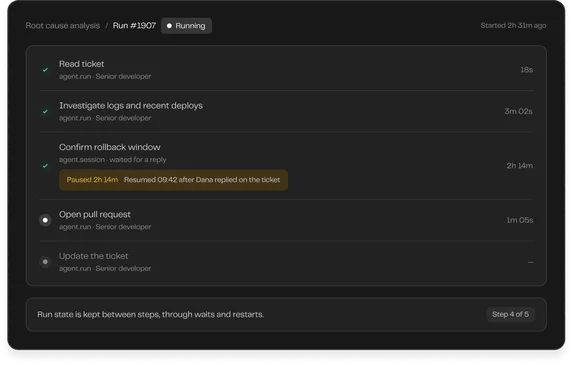
Long-running & stateful
Workflows persist across steps, survive human-in-the-loop waits, and version safely over time.
Capabilities
- Long-running & stateful
- Scheduled & continuous
- Workflow versioning

“In the age of AI, scaling engineering is about increasing the effectiveness of every engineer. Overcut gives us a framework for bringing agentic workflows into the SDLC while preserving governance, quality, and engineering standards.”
80%
of tickets triaged automatically
100%
of agentic workflows governed









Everything a real workflow needs
The building blocks for workflows that run in production, not demos.
See all featuresExecution
- #1
Triggers & events
PRs, ticket changes, labels, comments, or schedules start a run automatically.
- #2
Scheduled & continuous
Run 24/7 on recurring rules to keep backlogs from piling up.
- #3
Long-running & stateful
Workflows persist across steps and survive human-in-the-loop waits.
- #4
Parallel agents
Run specialized agents concurrently and join their results.
Control
- #5
Approvals & retries
Gate on human checkpoints; retry transient failures automatically.
- #6
Locking & prioritization
Prevent agent collisions and run work in a deliberate order.
- #7
Visual workflow designer
Compose and maintain complex flows with a clear mental model.
- #8
Workflow versioning
Measure quality over time and roll back safely when needed.



Your AI software factory starts with one command
The same AI everyone has. Run with the security, control, and scale enterprises actually require.
Questions teams ask
What starts a workflow?
Pull requests, ticket changes, labels, comments, schedules, or custom events emitted by your own systems.
Can a workflow wait for a person?
Yes. Workflows are long-running and stateful, so they persist across steps and survive human-in-the-loop waits and approval gates.
Can several agents work on the same task?
Run specialized agents in parallel and join their results. Locking and prioritization prevent collisions and keep execution orderly.
Do we have to build every workflow from scratch?
No. Start from a ready-made playbook such as code review, ticket triage, or fix CI, then adapt it in the visual workflow designer.
What happens when a step fails?
Transient failures retry automatically, and runs resume safely after interruptions.
