Autonomous Agent
A copilot waits for you to ask. You write a prompt, it suggests, and you decide what to do with the answer; the developer stays the one driving every step. An autonomous agent works the other way around. You give it a goal, and it figures out the steps itself: what to look at, what to do next, and which tool to use, looping until the work is done or it hits a point that needs a person. It is the difference between an assistant you operate and a worker you assign.
Overview
An autonomous agent is the actor that does the work inside an agentic workflow. Where the workflow is the defined process and the Agentic SDLC is the system around it, the agent is the worker filling one step: given the goal for that step, it reasons its way to a result. That is the unit Overcut puts on real lifecycle tasks, running root cause analysis, fixing a failing build, reviewing a pull request, rather than a developer prompting a model one line at a time.
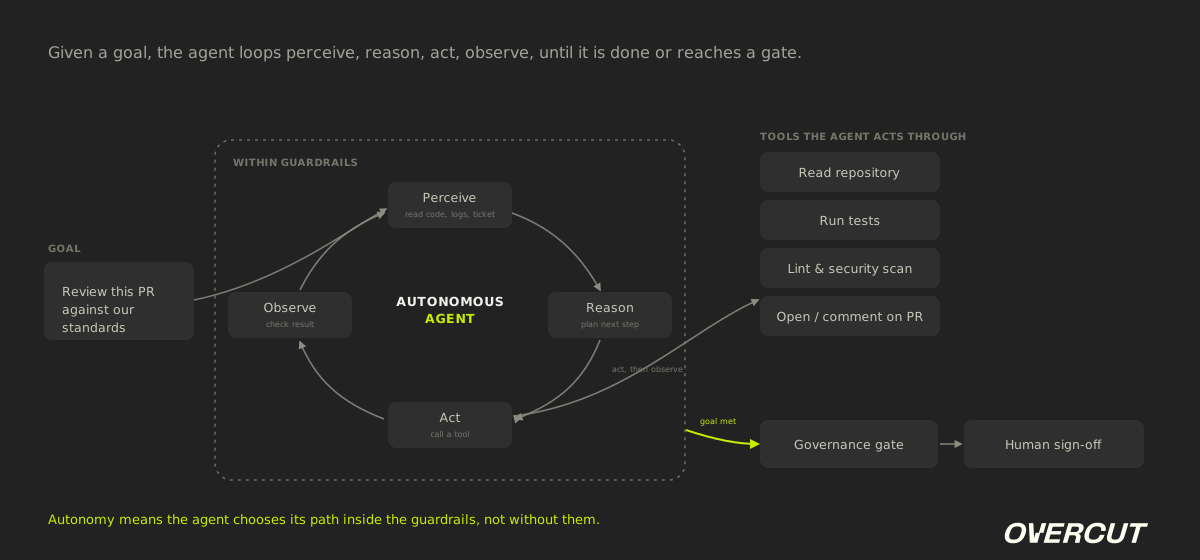
What makes it autonomous is the loop. The agent perceives its environment by reading the code, logs, or ticket in front of it; reasons with a model about what to do; acts through a tool; observes the result; and repeats. For how teams adopt it, the key point is that autonomy is a dial, not a switch. More autonomy scales the work but compounds the cost of a wrong turn, which is why an agent in Overcut runs inside guardrails, acts only through scoped tools, and stops at the gates where a human stays in the loop. The agent moves fast on its own; the boundary keeps where it can move under control.
How it works
An autonomous agent turns a goal into actions through a repeating loop, with tools as its only reach into the world. Four properties define it:
Given a goal, not a script
You hand the agent an objective and what success looks like, then it works out the steps. A person defines the destination; the agent decides the route, which is what separates it from automation that runs a sequence someone wrote in advance.
The perceive-reason-act loop
The agent gathers context, reads code, logs, a ticket, reasons with a model about what to do next, takes one action through a tool, then observes the result and loops. It repeats until the goal is met or it reaches a point that needs a human.
Tools are how it acts
An agent changes the world only through the tools it is given: reading a repository, running tests, opening a pull request, calling an API. Its capability is exactly that set of tools and the scope each one is granted, nothing wider.
Autonomy bounded by guardrails
"Autonomous" means the agent chooses its path, not that it acts without limits. It runs under scoped permissions and policy and stops at governance gates for sign-off. Limited supervision, not none, is what makes the autonomy safe to grant.
Example in practice
A pull request opens, and a review agent is assigned a single goal: review this change against the team's standards. Nobody scripts what it does next. The agent pulls the diff, then decides on its own to read the changed files and the code around them to understand the context. It reasons about correctness, security, and style, and runs the linter and the test suite as tools to check its read. It posts inline comments where it found problems and flags one risky change that it judges needs human eyes, then stops at the gate before anything merges. A developer reviews the agent's findings and approves. A copilot in the same repository would have done none of this on its own; it would have answered only if someone selected a line and asked.
What is Autonomous Agent?
An autonomous agent is a goal-directed AI worker that plans and carries out multi-step tasks by reasoning and calling tools, deciding its own steps toward an objective instead of following a fixed script, and running with limited supervision inside set guardrails.
Comparison: Autonomous agent vs. the AI assistant / copilot
The three sit on a line of decreasing human involvement: a script runs fixed steps with no judgment, a copilot adds judgment but needs a person driving each prompt, and an autonomous agent carries a goal through to a result on its own, within the limits you set.
Put autonomous agents to work across your SDLC
Overcut runs goal-directed agents on real lifecycle tasks, inside the guardrails you set and the gates you choose, so autonomy always stays under control.
Get a demoRelated content

By Overcut· 1 min read
Overcut named in the 2026 Gartner® Innovation Insight: AI Software Factories report
By Yuval Hazaz· 15 min read
Context Engineering: The Discipline Behind Reliable AI Agents
By Yuval Hazaz· 10 min read