Multi-Agent System
A single agent is good at a single, well-scoped task. Software delivery is not one task. A pull request needs a security read, a test-coverage check, and a style pass; an incident needs triage, a root-cause hunt, and a fix. A multi-agent system is how that breadth gets covered: instead of one agent stretched across every concern, a set of specialized agents each own a part of the work and combine their results.
Overview
The idea predates today's AI. Multi-agent systems come from distributed artificial intelligence, where the insight was that some problems are better solved by a network of cooperating problem-solvers than by one large solver. Michael Wooldridge's classic description, a loosely coupled network of agents that interact to solve problems beyond any one of them, still holds. What changed is that the agents are now language-model workers that can read code, call tools, and reason about a task.
In the software lifecycle, a multi-agent system is the concrete shape of a virtual engineering team. Rather than ask one agent to review, fix, test, and document, you give each job to an agent scoped for it, the way a real team has reviewers, on-call engineers, and writers. That brings two advantages a single agent cannot match: specialization, because a narrowly scoped agent is more accurate than a generalist, and parallelism, because independent agents run at the same time. The open question a multi-agent system always raises is coordination: who does what, in what order, and where the results come back together. That question is answered by agentic orchestration, the layer that coordinates the team.
How it works
A multi-agent system turns one large job into several scoped ones and combines the results. Four properties make it work:
Specialists, not one generalist
Each agent is scoped to a role it does well: one reviews for security, one checks test coverage, one writes the migration. Narrow scope means sharper prompts, the right tools, and fewer ways to go wrong than one agent told to do everything.
They divide the work
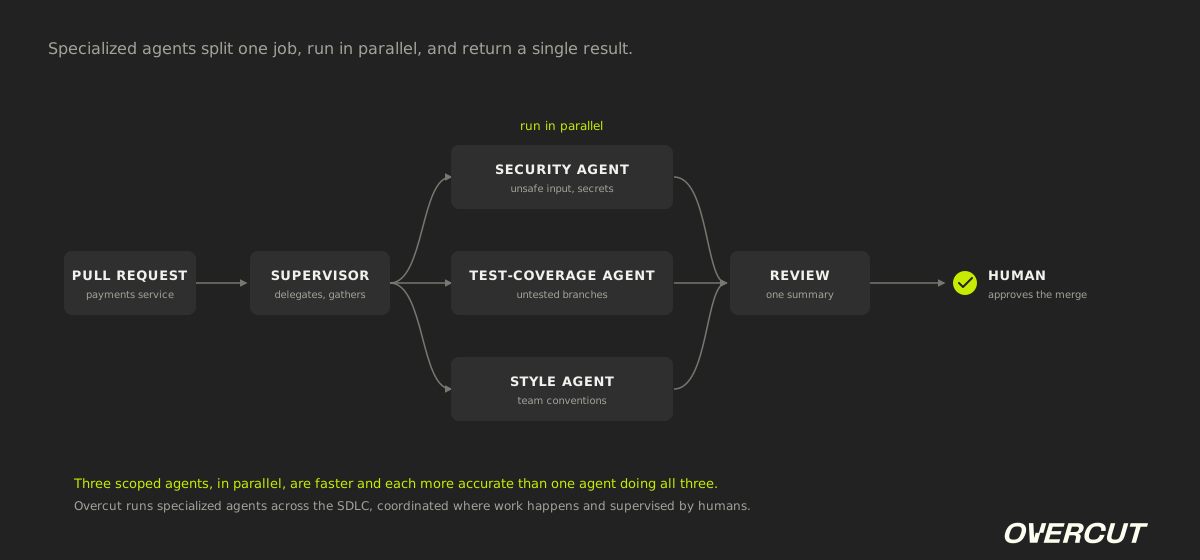
A larger job is split across agents that can run at once. A pull request can be read by a security agent, a style agent, and a test agent in parallel, so the whole review finishes in the time the slowest one takes, not the sum.
They coordinate through a pattern
Agents are arranged in a known shape: a supervisor that delegates and gathers results, a peer network that hands work across, or a hierarchy of both. The pattern decides who calls whom and where results come back together.
Humans stay in control of the team
A multi-agent system does not mean unattended. People set each agent's scope and tools, decide which outputs need sign-off, and review results, so a team of agents scales without giving up oversight.
Example in practice
A pull request opens against a payments service. Instead of one agent reading the whole diff, a multi-agent system fans it out. A security agent checks for unsafe input handling and secrets, a test-coverage agent flags the new branch that no test exercises, and a style agent checks the change against the team's conventions. They run at the same time, each with its own scope and tools, and a supervisor gathers their findings into one review comment. A human reads that single summary and approves the merge. One agent doing all three would be slower and easier to confuse; three scoped agents are faster and each more accurate at its job.
What is Multi-Agent System?
A multi-agent system is a model where several specialized AI agents work together on a problem that is too large or too varied for a single agent, each owning a role and contributing to a shared goal.
Comparison: Multi-agent system vs. the Single agent
A multi-agent system is not always the answer. A single, well-scoped task is often better served by one agent, with no coordination to manage. The model earns its place when the work is large and spans skills no single agent does well at once.
Put a team of agents to work
Overcut runs specialized agents across your SDLC, coordinated where work already happens and supervised by humans, so a virtual engineering team scales with your codebase.
Get a demoRelated content

By Overcut· 1 min read
Overcut named in the 2026 Gartner® Innovation Insight: AI Software Factories report
By Yuval Hazaz· 15 min read
Context Engineering: The Discipline Behind Reliable AI Agents
By Yuval Hazaz· 10 min read