Task Decomposition
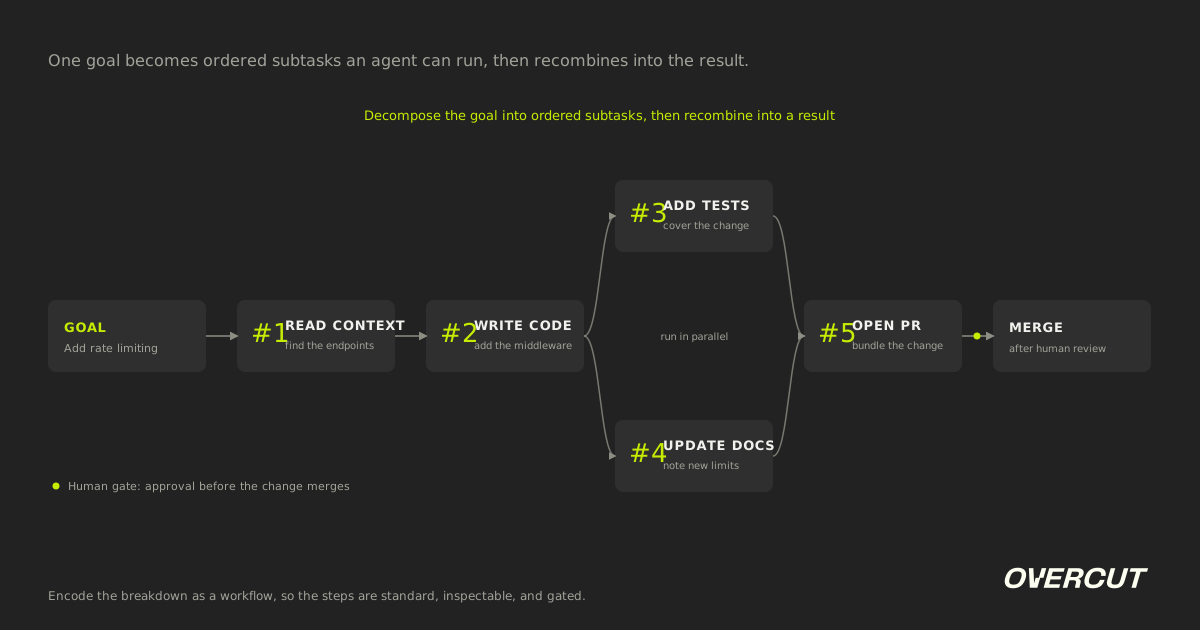
Ask an agent to "add rate limiting to the API" and a single prompt will not get you there reliably. The job hides several smaller jobs: find the endpoints, write the middleware, cover it with tests, update the docs, open the pull request. Task decomposition is the step that makes that explicit. It is how a vague, high-level goal becomes a list of concrete units of work an agent can actually execute.
Overview
Decomposition sits at the front of an agent's plan-and-act loop. Before any code is written, the agent has to decide what "done" is made of: which subtasks the goal contains, what each one needs, and which depend on others. Without that step, an agent either tries to do everything in one pass and gets it half right, or wanders through actions with no sense of the whole. It is the same divide and conquer idea that has run through AI planning for decades, now applied to large language model agents working on real software.
The reason it matters more in the agentic SDLC is scale. A single model call can do a small, well-defined step well. It cannot reliably carry a migration across fifty services or a feature from ticket to merged PR. Decomposition is what bridges that gap: it breaks the large request into steps small enough to trust, then lets autonomous agents run them. In Overcut, that breakdown does not have to be improvised on every run. It can be encoded as an agentic workflow or a playbook, so the decomposition is standard, inspectable, and gated rather than reinvented each time.
How it works
Task decomposition takes one goal and produces an ordered set of subtasks an agent can run. Four moves make it work:
Split the goal into subtasks
A high-level request like "modernize this service" is too large for one reliable step. Decomposition turns it into concrete units of work: read the code, find dependencies, update tests, refactor, validate the build. Each subtask is something a single agent action or tool call can finish.
Map the dependencies
Subtasks rarely sit in a flat list. One output feeds the next, and some can run in parallel while others must wait. The breakdown forms a dependency graph that fixes the order, so the agent does not write tests for code that does not exist yet.
Plan first or decompose as you go
Decomposition-first lays out the whole tree before any work starts, which is predictable but rigid. Interleaved decomposition splits one step at a time and reacts to what it learns, which adapts to surprises but can drift from the original goal.
Execute, check, and recombine
Agents run the leaf subtasks, each result is checked, and the outputs roll back up into the finished work. A wrong early subtask poisons everything downstream, so verification between steps is what keeps the whole breakdown honest.
Example in practice
A continuous integration build starts failing on the main branch. The goal, "fix CI," is not one action, so the agent breaks it down. First it reads the job logs to see which step failed. Then it reproduces the failure in an isolated environment, narrows it to a unit test that broke after an API response changed shape, and decides on a fix. It updates the test fixture, reruns the suite to confirm the build is green, and opens a pull request with the change. Each of those is a subtask small enough for an agent to do and check, and they run in order because each one depends on the result of the last. A human approves the PR before it merges.
What is Task Decomposition?
Task decomposition is breaking a complex goal into smaller, ordered subtasks, each small enough for a single action, tool call, or agent to complete, then recombining the results to satisfy the original goal.
Comparison: Task decomposition vs. the Chain-of-thought reasoning
Chain-of-thought reasons through one problem, decomposition splits one goal into subtasks, and orchestration coordinates many of those tasks across the organization. They stack: reasoning can produce a breakdown, and orchestration runs the pieces it creates.
Turn big requests into work agents can run
Overcut encodes the breakdown as workflows and playbooks, so a large task becomes standard, inspectable steps with humans gating the points that matter, instead of a plan improvised on every run.
Get a demoRelated terms
Related content
By Overcut· 1 min read
Overcut named in the 2026 Gartner® Innovation Insight: AI Software Factories report
By Yuval Hazaz· 15 min read
Context Engineering: The Discipline Behind Reliable AI Agents
By Yuval Hazaz· 10 min read