Playbook
Most teams keep solving the same lifecycle tasks over and over: the build breaks and someone fixes it, a pull request needs a review, a ticket needs triage. A playbook captures a working version of one of those tasks once, as a template you can import and adapt, so the proven process becomes something you reuse rather than rebuild. It is the difference between a process that lives in one engineer's head and one that any team can pick up and run.
Overview
A playbook is the reusable form of an agentic workflow. The workflow is what actually runs when an event fires; the playbook is the packaged template you start from to get there. In Overcut, that template is a concrete artifact: a workflow definition you import into the builder, an editable prompt for each step, and the triggers and documentation that come with it. You can pick a prebuilt playbook, such as PR review or root cause analysis, or author your own.
That packaging is what makes organizational standardization practical. Without playbooks, every team that wants automated code review or CI fixing designs the workflow themselves, and the results drift apart. With them, one proven process is imported, adapted to each codebase, and run the same way everywhere. Overcut ships playbooks both in the product and as open playbooks in a public repository, so a team adopts a known-good starting point and keeps improving it, rather than starting from a blank canvas each time.
How it works
A playbook turns a proven workflow into a portable artifact you import and adapt. Four properties make it work:
A packaged template
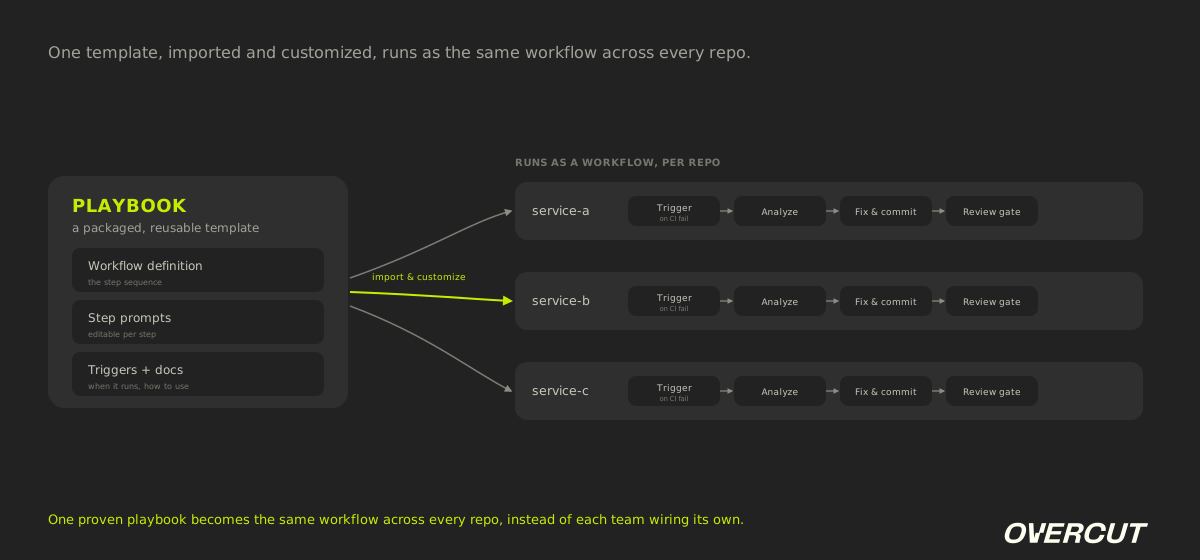
A playbook bundles everything a workflow needs: the definition of the step sequence, an editable prompt for each step, and the triggers and conditions that start it, along with documentation. It is a concrete artifact, not a vague best practice.
Import, then customize
You import the playbook and tune it to your codebase: adjust the prompts, change the triggers, set the gates. It is a starting point you adapt, not a black box you accept as-is, so a shared template still fits each team's specifics.
From proven use case to running workflow
A playbook captures a use case that already works, fixing a failing build, reviewing a pull request, triaging a ticket, so a team adopts a known-good process. Once configured, it runs as a workflow on every matching trigger.
Shared and standardized
Because a playbook is portable, the same proven process spreads across repos and teams instead of each one wiring its own. Overcut ships playbooks in the product and as open playbooks in a public repository, and each can evolve over time.
Example in practice
A team wants failing builds handled without someone babysitting the CI tab. Instead of designing the automation, they import the Fix CI playbook. It arrives complete: a trigger bound to a failed CI run on a pull request branch, two steps each with an editable prompt, one that analyzes the failure and finds the root cause and one that applies the fix and commits it, and documentation describing how it runs. They point it at their repository, adjust the analysis prompt for their stack, and add an approval gate so a human signs off before any push. From then on, every failing build on a PR triggers the configured workflow. When a second team needs the same thing, they import the same playbook for their service rather than reinventing it. One process, proven once, reused everywhere.
What is Playbook?
A playbook is a reusable template that packages a proven agentic workflow, its steps, prompts, and triggers, so a team can import it, customize it, and run it instead of building the same automation from scratch.
Comparison: Playbook vs. the Agentic workflow
A runbook is a procedure you read, an agentic workflow is a process that runs, and a playbook is the reusable template that turns the first into the second and lets you spread it across teams.
Start from a proven playbook
Overcut ships prebuilt, customizable playbooks for the work your team does every day, so you import a process that works and adapt it, instead of building automation from zero.
Get a demoRelated content
By Overcut· 1 min read
Overcut named in the 2026 Gartner® Innovation Insight: AI Software Factories report
By Yuval Hazaz· 15 min read
Context Engineering: The Discipline Behind Reliable AI Agents

By Yuval Hazaz· 10 min read