
Automated Code Review
Code review is where good changes wait. A pull request sits until a senior engineer has time, the depth of the review depends on who happens to look and how busy they are, and the obvious issues eat the attention that should go to the hard ones. Automated code review changes the starting point: every PR gets an immediate, consistent first pass, so by the time a person looks, the easy problems are already flagged and the reviewer can spend their judgment where it counts.
Overview
Automated code review is one of the standard use cases of the Agentic SDLC, delivered as a playbook you import and tune to your standards. It is an agentic workflow triggered when a pull request opens: an agent reads the change, checks it for bugs, security, performance, and style, and posts inline comments with a review summary. The point is consistency. Every PR, in every repo, gets the same first-class review instead of one that varies with the reviewer's workload.
It is worth being precise about what it is not. It is not a linter: a linter enforces fixed rules and catches formatting and known patterns, while automated code review reads the intent of a change and can catch a semantic bug that no rule describes. And it is not a replacement for the human reviewer. It runs as a first pass that posts findings and can request changes, but the merge stays a human decision at a gate. The strongest setups keep all three: linters as deterministic gates, the agent for contextual feedback before merge, and a person who approves. Overcut's role is to make that first pass standard across the organization rather than a tool each team wires up on its own.
How it works
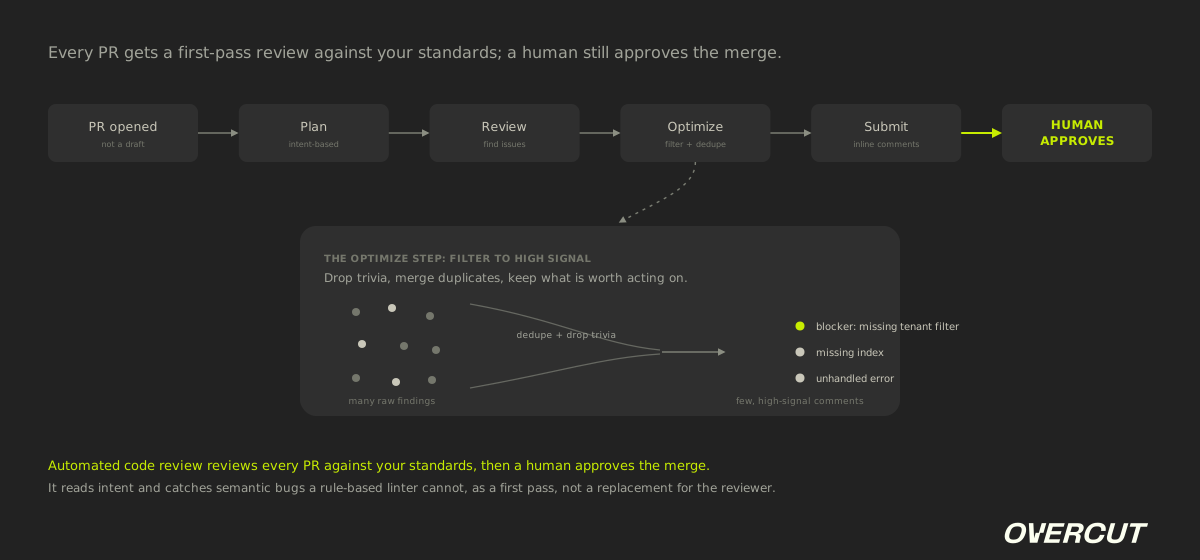
Automated code review runs as a short pipeline: plan the review around the real changes, review against your standards, filter to what matters, and post. Four properties define it:
Runs on every pull request
The review is triggered the moment a PR opens, or on demand with a command, so every change gets a first pass automatically. Nothing waits in a queue for a senior engineer to find a free hour, and no PR slips through unreviewed.
Reviews against intent, not just rules
It first builds a plan around the main logical changes, then checks each one for bugs, security, performance, and best practices against your team's standards. It reads the change the way a senior engineer would, with an eye for intent and consequence, which is what catches semantic problems a rule-based linter cannot.
High-signal, not noise
A dedicated step dedupes and filters the findings, dropping trivia and merging duplicates, so the PR gets a short list of comments worth acting on instead of a wall of nitpicks. Severity thresholds are yours to set.
A human still approves
It posts inline comments and a review summary, and it can request changes, but it does not merge. The human reviewer reads the agent's findings and makes the call, so the workflow speeds up review without taking the decision away.
Example in practice
An engineer opens a pull request adding a new endpoint to a multi-tenant service. The moment it opens, automated code review runs. It plans the review around the main change, the new database query path, and checks it against the team's standards. It finds that the query does not filter by tenant, a data-isolation bug a linter would never catch, along with a missing index and an unhandled error on a failed lookup. It filters out two stylistic nits as low-value, posts three inline comments tied to the exact lines, writes a summary, and requests changes. The author fixes the tenant filter and the error handling before a human reviewer has even opened the PR. The senior engineer then reviews a clean, focused diff and approves the merge, having spent none of their time on what the agent already caught.
What is Automated Code Review?
Automated code review is an agentic workflow that reviews every pull request against your standards and posts actionable findings before a human approves the merge, giving each change a consistent first pass for bugs, security, performance, and style.
Comparison: Automated code review vs. the Human review
These are layers, not rivals: linters gate the deterministic rules, automated code review adds contextual feedback on every PR, and the human reviewer still owns the decision to merge.
Give every PR a consistent first review
Overcut ships automated code review as a prebuilt playbook: it reviews each pull request against your standards and posts high-signal findings, leaving the merge decision to your team.
Get a demoRelated content

By Overcut· 1 min read
Overcut named in the 2026 Gartner® Innovation Insight: AI Software Factories report
By Yuval Hazaz· 15 min read
Context Engineering: The Discipline Behind Reliable AI Agents

By Yuval Hazaz· 10 min read