Ephemeral Development Environment
Most development environments are meant to last. A staging server, a shared QA box, or a long-running dev cluster is set up once and kept alive, which means it slowly drifts: leftover data, half-finished changes, and config tweaks pile up until no one is sure what state it is in. An ephemeral development environment takes the opposite stance. It exists only for as long as a single piece of work needs it, then it is gone.
Overview
The idea grew out of cloud-native CI/CD, where teams began spinning up a full environment for each pull request so reviewers could click through a change before merging, then destroying it on merge. The same pattern, an environment that is created from a definition, used for one job, and discarded, turns out to be far more general than code review. Anything that needs a clean place to run and should not leave a mess behind fits it.
That generality is why ephemeral environments matter for autonomous agents. When a person works, they implicitly reset between tasks: a fresh branch, a clean checkout, a restart. An agent running many tasks across many repos has no such instinct, so the reset has to be built in. Giving each task its own environment that is torn down afterward means one agent's work cannot contaminate the next, failures are thrown away rather than nursed back to health, and the same task run twice starts from the same place both times. The disposability is the point: it is what makes repeated, parallel, unattended work safe to run.
How it works
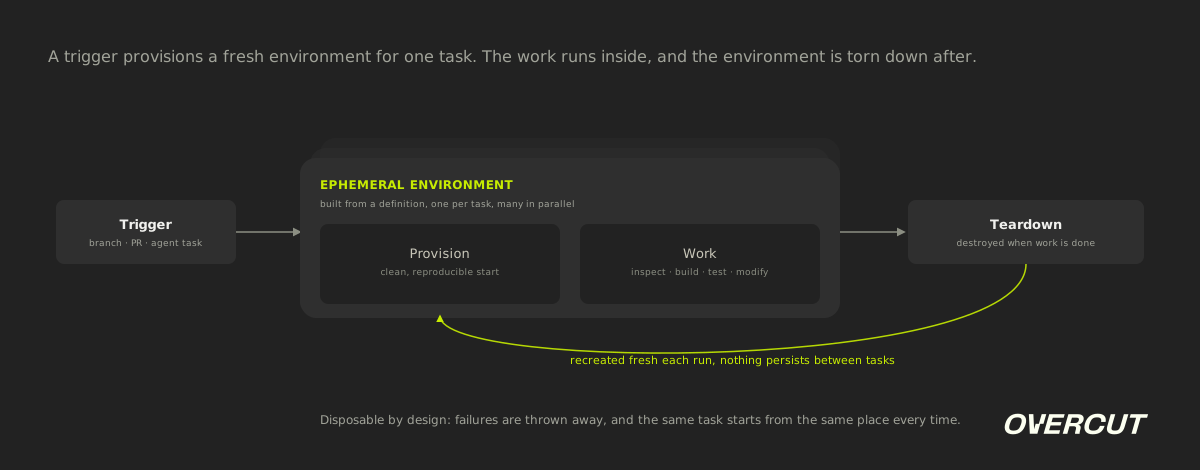
An ephemeral environment is defined as code, brought up when a trigger fires, used for one job, and torn down after. Four properties make the model work: how it is created, what state it starts in, what happens to it afterward, and how many can exist at once.
Created on demand
A trigger such as a new branch, a pull request, or an agent task provisions a fresh environment from a definition. There is no manual setup and no waiting for a shared machine to free up.
Clean and reproducible
Every environment starts from the same known state, built from code rather than configured by hand. No leftover files, no configuration drift, and no interference from other work in progress.
Torn down after the task
When the work is done the environment is destroyed. Nothing persists between runs, so no state leaks from one task into the next and idle infrastructure does not pile up.
Parallel by default
Because each environment is independent and disposable, many can run at once. Ten branches or ten agents each get their own clean space instead of competing for one staging server.
Example in practice
A nightly build fails across a dozen services after a shared dependency ships a breaking change. Rather than queue the fixes through one shared environment, each service's remediation runs in its own ephemeral environment. An agent gets a fresh workspace built from that service's definition, reproduces the failure, applies a fix, and runs the suite until the build is green. The moment it opens the pull request, the environment is destroyed. Twelve fixes proceed in parallel, none of them sees the others' state, and nothing is left running once the work is done.
What is Ephemeral Development Environment?
An ephemeral development environment is a temporary, on-demand workspace that is created for a single piece of work and torn down once it is finished, so nothing persists or carries over between runs.
Comparison: Ephemeral development environment vs. the Persistent environment
A persistent environment is defined by being always on; an ephemeral one is defined by its short, disposable lifecycle. An isolated execution environment is a closely related idea seen from a different angle: it describes the boundary around the work, while ephemeral describes how long that work's environment lasts. In practice an agent's workspace is usually both, isolated and ephemeral at once.
Give every agent a fresh workspace
Overcut runs each task in its own on-demand environment that is torn down when the work is done, so agent work stays clean, parallel, and predictable.
Get a demoRelated terms
Related content
By Overcut· 1 min read
Overcut named in the 2026 Gartner® Innovation Insight: AI Software Factories report
By Yuval Hazaz· 15 min read
Context Engineering: The Discipline Behind Reliable AI Agents
By Yuval Hazaz· 10 min read