Root Cause Analysis
When something breaks, the fastest move is to make the symptom stop: restart the service, rerun the job, revert the change. That clears the alert, but it does not explain why the failure happened, so it tends to come back. Root cause analysis is the discipline of not stopping there. It works backward from a failure to the condition that actually caused it, so the fix addresses the source.
Overview
RCA is an old idea with a manufacturing pedigree. The 5 Whys, still the most common technique, was developed by Sakichi Toyoda at Toyota in the 1930s as part of what became the Toyota Production System; fault tree analysis grew out of aerospace reliability work. The thread connecting them is a refusal to treat the first visible problem as the real one. You keep asking why until you reach a cause that, if fixed, stops the failure from happening again.
In software the practice shows up in incident response and blameless postmortems, and it comes with a caveat worth stating plainly: complex systems rarely have a single root cause. A production incident is usually the product of several contributing factors that line up at the wrong moment, which is why mature teams ask "what contributed to this?" rather than hunting for one culprit. The goal is not a tidy single answer but a defensible account of what went wrong and which few factors are worth fixing.
How it works
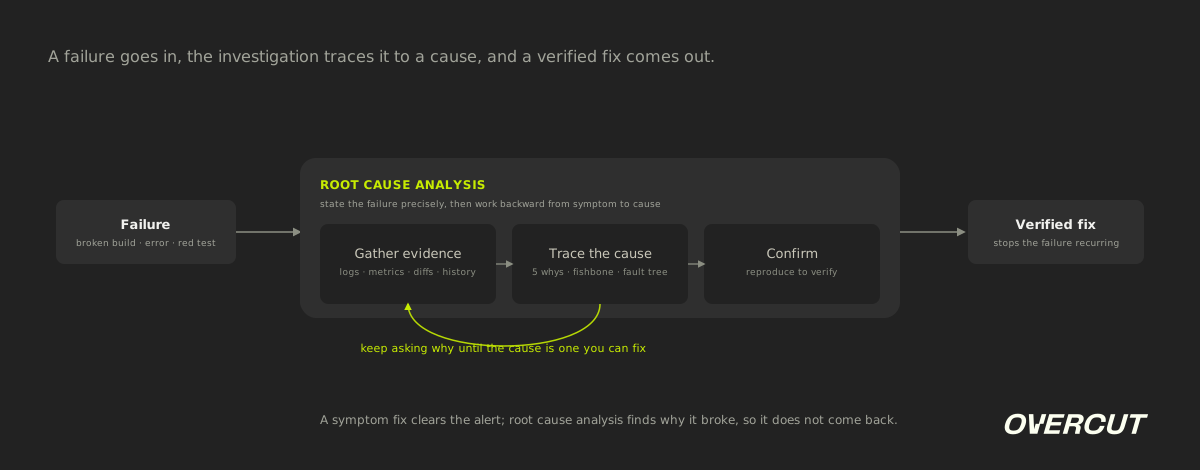
Whatever the method, RCA follows the same shape: state the failure precisely, gather the evidence around it, trace from symptom to cause, then confirm the cause and fix it. The technique you reach for depends on the problem. The 5 Whys is fast and works for linear failures; a fishbone diagram organizes many candidate causes into categories; fault tree analysis models how combinations of failures propagate when the stakes are high.
Start from the failure
An investigation begins with a clear, specific problem statement: the build that broke, the request that errored, the test that flipped red. A vague symptom produces a vague answer, so the first job is to pin down exactly what went wrong and when.
Gather the evidence
Collect the signals around the failure: logs, metrics, traces, recent code changes, and similar past incidents. Good RCA reasons from evidence rather than hunches, and keeps the trail so the conclusion can be checked later.
Trace cause from symptom
Work backward from what failed to why, using a method like the 5 Whys, a fishbone diagram, or fault tree analysis. Each step asks what had to be true for the previous one to happen, until you reach a cause you can actually fix.
Confirm, then fix
Reproduce the failure to confirm the suspected cause really explains it, then address that cause so the problem does not recur. A diagnosis nobody verifies is a guess, and a fix aimed at the symptom buys only time.
Example in practice
A scheduled deploy starts failing across several services with the same opaque timeout. The on-call engineer could rerun the pipeline and hope, but instead an RCA workflow runs the investigation. It pulls the failing job logs, strips the noise down to the lines that matter, diffs the change that landed just before the first red build, and reproduces the failure in a throwaway environment. The trail points to a shared library that started enforcing a shorter default timeout. That is the cause, named with evidence behind it, and the fix is to set the timeout explicitly rather than restart the deploy and wait for it to break again tomorrow.
What is Root Cause Analysis?
Root cause analysis (RCA) is a systematic investigation that traces a failure back to the underlying cause that produced it, so the fix addresses the source of the problem rather than its symptoms.
Comparison: Root cause analysis vs. the Symptomatic fix
A symptomatic fix and RCA are not rivals: when something is on fire you often apply the quick fix first, then run RCA so it does not recur. Debugging is a tool RCA uses, narrowing a problem to a line of code, but RCA is wider, since the real cause may be a process gap or a missing check rather than a bug.
Diagnose failures the same way every time
Overcut runs root cause analysis as a standard agentic workflow: an agent gathers the evidence, traces the cause, and hands you a diagnosis to approve before any fix advances.
Get a demoRelated terms
Related content

By Overcut· 1 min read
Overcut named in the 2026 Gartner® Innovation Insight: AI Software Factories report
By Yuval Hazaz· 15 min read
Context Engineering: The Discipline Behind Reliable AI Agents
By Yuval Hazaz· 10 min read