How Are AI Agents Transforming Automated Ticket Triage for Engineering Teams
Somewhere on your team there is an engineer who spends the first hour of every day reading tickets. A bug report lands, and before anyone can fix it, someone has to read it, decide whether it is real, guess which part of the codebase it touches, check whether it duplicates something already open, set a priority, and assign it to a person. None of that is the work. All of it stands between the report and the work. When the queue is small you barely notice. When it grows, that gap between "a ticket exists" and "the right engineer is looking at it" becomes one of the most expensive things your team does without ever putting it on a roadmap.
Automated ticket triage is the attempt to close that gap. For years it meant rules: if the title contains "login," route to the auth team; if the reporter is on the enterprise plan, bump the priority. Those rules helped a little and aged badly. AI agents change the shape of the problem, because an agent can read a ticket the way a person does, look at the actual code and logs, and reason about where it belongs. This post walks through what that shift really buys you, where it holds up, and where it still needs a human.
Key Takeaways
- Manual triage is a recurring tax that scales with volume. A team running 200 tickets per sprint can lose 5 to 10 hours a week just reading, labeling, and routing before any fixing starts.
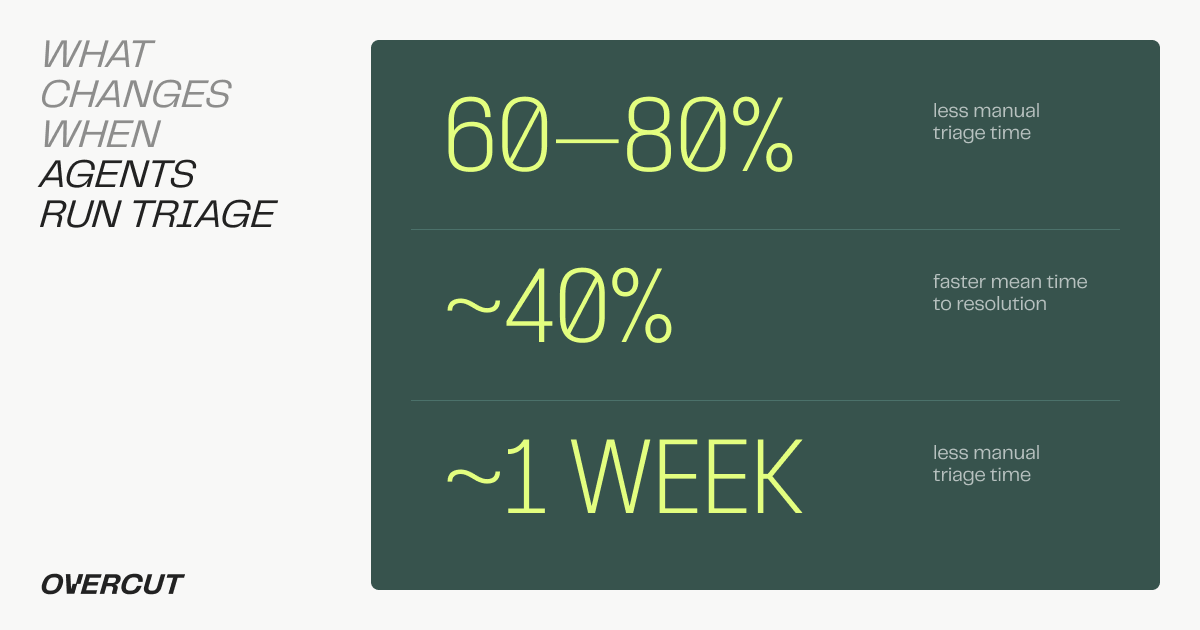
- AI agents reliably handle the mechanical judgment in triage: classification, duplicate detection, priority scoring, and routing. Teams report 60 to 80% reductions in manual triage time and around 40% faster mean time to resolution.
- Agents are not a replacement for engineering judgment. High-severity incidents, ambiguous reports, and security-sensitive tickets still need a human call, which is why confidence thresholds matter more than raw accuracy.
- The end-to-end workflow runs from intake to a scoped hand-off: read, reproduce, deduplicate, classify, route, and in the clear cases draft a fix, then stop for a person.
- The gain is not just speed. When triage stops being a bottleneck, prioritization becomes continuous instead of a weekly ceremony, and engineers spend attention on decisions rather than queue maintenance.
What Manual Ticket Triage Actually Costs Engineering Teams Every Week
The cost of manual triage is easy to underestimate because it hides inside everyone's day rather than showing up as a line item. Reading and routing a single ticket takes a minute or two when it is obvious and much longer when it is not. Multiply that across a real queue and the numbers get uncomfortable. A team processing around 200 tickets a sprint can spend 5 to 10 hours every week on triage alone, and that is before a single line of code gets written.
Two failure modes make it worse, and both compound as you scale. Duplicates are the first. Studies on large open-source trackers like Mozilla and Eclipse found that duplicate reports consume 15 to 25% of total triaging effort, because catching a duplicate requires someone to remember or search for what already exists. The second is misrouting. When a ticket goes to the wrong engineer, that person spends real hours getting up to speed on code they do not own before bouncing it onward, and getting routing wrong can waste 20 to 30% of the eventual fixing time. Both get worse as teams split into more squads. The load spreads across more people, but no single person holds the whole picture anymore, so recognizing a duplicate or knowing who owns what gets harder exactly when there is more of it to do.
What AI Agents Can and Cannot Do in Ticket Triage Today
The line between what agents handle well and what they should not touch is clearer than most of the marketing suggests.
What agents do reliably is the mechanical judgment that used to require a person only because it required reading. An agent can classify a ticket by type and component, detect that a new report duplicates an existing one by comparing meaning rather than matching keywords, assign a priority from severity signals, and route to the right owner based on the code and history rather than a brittle rule. On mature deployments, classification accuracy lands in the 85 to 95% range, well above the 40 to 50% ceiling that rules-based systems tend to hit and above the 60 to 70% that manual categorization achieves when a tired human is doing it at 4pm. Agents also read the surrounding context. They can inspect the codebase, pull from observability tools, and connect a new alert to an earlier thread to deduplicate incidents automatically.
Where agents should not go alone is the calls that carry real consequences, and the right pattern there is suggestion rather than silence. A high-severity production incident, a report where the underlying request is unclear, a security-sensitive ticket, or a judgment about whether a fix is worth shipping now all belong to a person. That does not mean the agent steps back entirely. It does the investigation, proposes a priority and an owner, writes down why, and then asks. The human sees a recommendation with the evidence attached and confirms it, changes it, or takes over, which is a very different job from reading a raw ticket cold. In practice this becomes a confidence threshold: route automatically when the agent is sure, ask for a one-click confirmation in the middle band, and hand the ticket over completely when confidence is low. The agent brings the reading and the reasoning; the person keeps the decision. That balance of autonomy and human control is the same principle we think defines the real future of AI development.
How Are AI Agents Transforming Automated Ticket Triage for Engineering Teams
Walk the workflow end to end and the transformation is concrete rather than abstract. It runs as a sequence, and an agent owns each step until it reaches the point where a human is genuinely needed.
Intake comes first. The agent watches the places tickets and alerts actually appear, whether that is Jira, Linear, GitHub, an incoming webhook, or a Slack thread, so nothing waits in a queue for a person to notice it. Then it reads the report the way an experienced engineer would, parsing what happened, what was expected, and what is missing, and it asks for the missing detail directly if the report is too thin to act on.
Next it tries to reproduce. This is where agents pull ahead of any rules engine, because the agent can inspect the codebase and the logs to check whether the issue is real and reproducible instead of taking the reporter's word for it. Alongside that, it runs deduplication, comparing the report against open and recently closed tickets by meaning, and links it to the existing thread when it finds a match instead of spawning a parallel effort. With reproduction and dedup done, classification and priority follow naturally: type, component, severity, and owner, each grounded in what the agent actually found rather than a guess from the title.
Then comes routing, and this is the heart of ticket routing automation. The agent assigns the ticket to the team or person who owns the relevant code, with a written summary of its investigation attached so the receiving engineer starts with context instead of a cold report. In the clearest cases, where the fix pattern is well understood, the agent goes one step further and drafts a code change or opens a draft pull request for review. Some systems spin up parallel sub-agents to investigate several incoming issues at once, so a burst of alerts does not serialize behind one worker. At every consequential boundary, whether that is assigning a critical incident or merging a fix, the workflow stops for a human. The Atlassian engineering team reported cutting up to 80% of the time on some repetitive maintenance tasks this way, saving roughly an engineering week a month on flaky-test handling alone by letting agents do the investigation and diagnosis while engineers kept approval over what merged.
None of this is a single monolithic model doing everything. It works because specialized agents each own a slice, intake, reproduction, dedup, routing, and drafting, and hand context between them. That orchestration is what we build Overcut around, running on the Jira automation and CI/CD systems teams already have rather than asking them to rebuild around a new platform. The automated ticket triage playbook is the packaged version of this exact workflow, ready to point at a repository and a tracker.
How Ticket Triage Automation Changes the Way Engineering Teams Prioritize Work
The operational change is bigger than the time saved. When triage is a manual bottleneck, prioritization happens in batches. Work piles up in a queue, and a lead or a planning meeting periodically drains it, deciding what matters in one sitting based on whatever made it to the top. Priorities are only as fresh as the last time someone sat down with the board.
When triage runs continuously in the background, that changes. Tickets arrive already read, reproduced, deduplicated, classified, and routed, so the queue a human looks at is a queue of decisions rather than a queue of raw material. The lead spends their time on the genuinely hard prioritization calls, the tradeoffs between competing real work, instead of the mechanical sorting that used to consume the meeting before the real discussion started. Teams that adopt this report the resolution numbers moving, with mean time to resolution improving around 40%, but the more durable change is that prioritization stops being a scheduled event and becomes a steady state.
There is a second-order effect on where senior attention goes. The scarce resource on any team is not typing speed, it is the judgment of experienced engineers, and manual triage spends that resource on work that barely needs it. Moving the mechanical judgment to agents, with humans staying on the consequential gates, is a mark of devops automation tools maturity: the automation absorbs the legwork and hands people back the decisions. The point was never to remove humans from the loop, it was to stop spending them on the parts of the loop that never needed them.
FAQs
Does AI ticket triage work across Jira and Linear?
Yes. Good triage agents connect to the trackers where work already lives rather than requiring a new one, so a single agent can read a Linear issue, act on a GitHub repository, and post back to Jira within one task. Integrations typically reach these systems through connectors or a standard like the Model Context Protocol, which is what lets one workflow span a mixed stack instead of locking you into a single vendor's ecosystem.
How does AI triage handle duplicate tickets?
By comparing meaning rather than matching keywords. The agent reads a new report and checks it against open and recently closed tickets, and when it finds a genuine match it links the two and routes the new one to the existing thread instead of creating parallel work. For live systems it can also connect a fresh alert to an earlier incident thread. This matters because duplicates otherwise consume 15 to 25% of total triage effort on large queues.
What accuracy is realistic for AI ticket classification?
On mature deployments, classification accuracy commonly lands in the 85 to 95% range, compared with a 40 to 50% ceiling for rules-based systems and 60 to 70% for manual categorization. The practical answer is to not chase a single number. Use confidence thresholds so the agent auto-routes only above a high-confidence mark, asks for a one-click human confirmation in the middle band, and hands low-confidence tickets to a person entirely.
How does automated triage interact with on-call escalation workflows?
It sits in front of them rather than replacing them. An agent can investigate an incoming alert, gather the logs and likely cause, and either resolve routine cases or hand a human a summary with context already attached, which shortens the time on-call spends orienting. Escalation to a person for high-severity incidents stays a human-gated decision, so the agent accelerates the investigation without ever deciding on its own to skip a page.
Can AI triage agents detect security vulnerabilities in tickets?
They can flag likely security relevance and route a ticket to the right owners faster, which is useful. They should not be trusted as your security review. A triage agent surfacing that a report looks like a potential vulnerability is a signal for a human security process to take over, not a verdict. Treat security-sensitive tickets as a category that always crosses a human gate, regardless of how confident the agent is.