6 ways engineering teams are using AI agent orchestration to scale
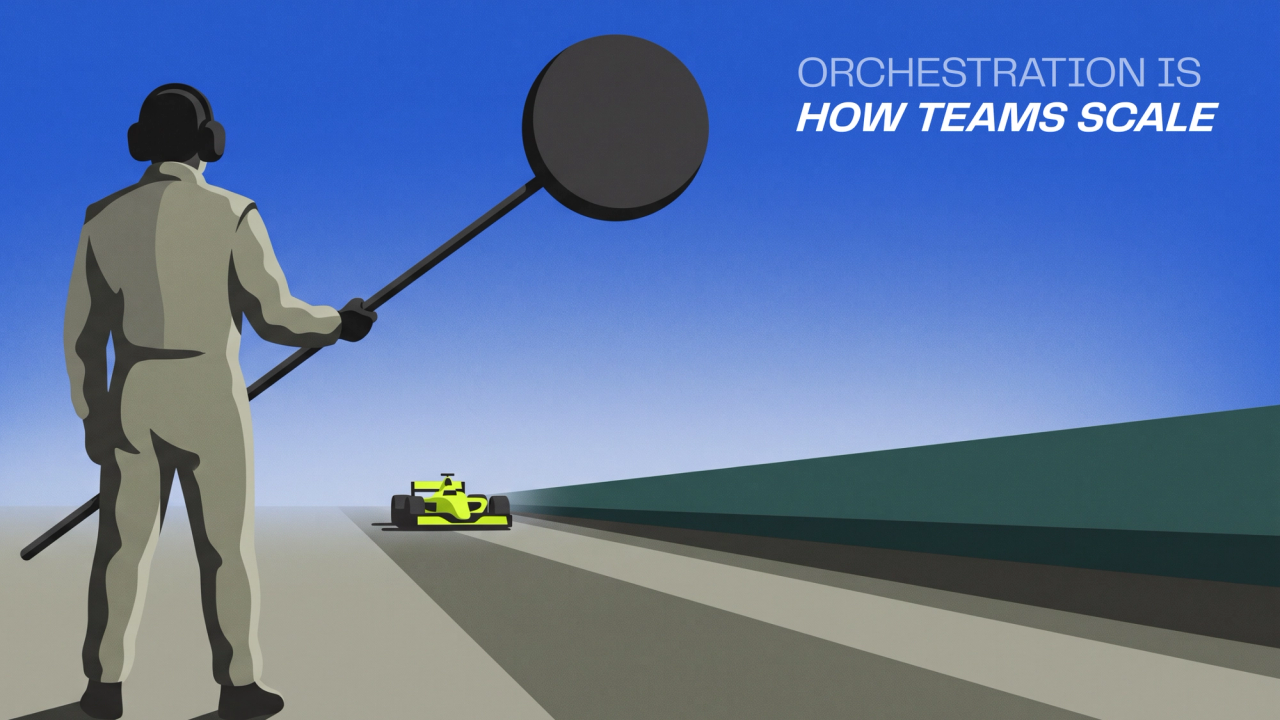
Most engineering teams already have an AI coding agent doing real work. It writes code, drafts tests, answers questions about the codebase. And yet the team is not noticeably faster, because the bottleneck moved. Someone still has to notice the ticket, hand it to the agent, read the output, pass it to review, chase the follow-ups, and remember where everything stands. The agent got fast. The coordination around it stayed manual, and the human became the router.
AI agent orchestration is what teams reach for when they get tired of being the router. Anthropic's 2026 Agentic Coding Trends Report describes the same shift from the other direction: the engineer's role is moving from implementer to orchestrator, from writing the code to running the system that writes it. The teams making that shift are converging on a handful of patterns, and the patterns are consistent enough now to name.
Key Takeaways
- AI agent orchestration coordinates multiple specialized agents across a workflow, which is qualitatively different from prompting one agent harder. The value comes from removing the human routing work between steps.
- The six use cases with the most traction span the whole SDLC: intake and triage, ticket-to-PR coding, review and test generation, large-scale migrations, CI and incident remediation, and documentation upkeep.
- Reliability at scale is an architecture problem, not a model problem. Event-driven design, shared context, and first-class human approval gates separate production systems from demos.
- For engineering leadership, the job shifts from monitoring individual output to monitoring workflow health: where agents run, what they can touch, and where humans stay in the loop.
What AI Agent Orchestration Is and Why It Is Different From Running a Single Agent
A single agent is a very capable function call. You give it a task, it works, it returns a result. That model breaks the moment the work spans more than one step, because real engineering work is a chain: a ticket becomes a plan, a plan becomes a change, a change becomes a review, a review becomes a merge, and every link needs context from the ones before it.
AI agent orchestration is the layer that runs that chain. Instead of one generalist agent holding everything in a single context window, orchestration coordinates multiple specialized agents, each owning one concern, sharing context and handing work to each other with defined triggers, permissions, and checkpoints. It borrows from two older disciplines. From workflow orchestration it takes the machinery of production automation: triggers, retries, state, observability. From what is now called llm orchestration it takes the model-facing concerns: routing tasks to the right model, managing context between calls, validating outputs before they propagate.
The difference from a single agent is not throughput, it is structure. One agent that fails mid-task leaves you a transcript to read. An orchestrated workflow that fails leaves you a specific step, with specific inputs, that a specific retry or a specific human can pick up. That property is what makes the difference between an impressive demo and something an organization can actually run.
6 Ways Engineering Teams Are Using AI Agent Orchestration to Scale
These are the six patterns we see most in production, roughly in the order teams adopt them.
Intake and triage. An agent watches the issue tracker, deduplicates new reports, reproduces bugs where it can, labels and prioritizes, and turns vague reports into scoped tickets with acceptance criteria. What it removes is the least loved job in engineering: the standing human rotation that reads raw intake so everyone else doesn't have to.
Ticket-to-PR coding. A scoped ticket triggers an AI coding agent that plans the change, writes it, runs the tests, and opens a draft PR with a summary of what it did and why. The human contribution shrinks to two decisions: is this ticket ready for an agent, and is this PR good enough to review seriously. The hours between those two decisions stop belonging to a person.
Code review and test generation. Every PR, human or agent authored, gets reviewed by agents checking logic, security, and team conventions, while another agent fills the test gaps the diff exposes. This removes the first-pass review burden that senior engineers quietly drown in, and reserves their attention for the judgment calls a model shouldn't make.
Large-scale migrations and refactors. A framework upgrade or API deprecation gets decomposed into hundreds of small, independent changes that agents execute in parallel, each verified against the build before a PR opens. This is the grinding, months-long project nobody volunteers for, and it is where orchestration's fan-out shows the most dramatic wins. Anthropic's report cites changes landing across a 12.5-million-line codebase in a single seven-hour run.
CI and incident remediation. When a build breaks or an alert fires, an agent gathers the failing logs, the recent diffs, and the deploy history, proposes a root cause, and either opens a fix PR or pages a human with the investigation already done. It removes the twenty minutes of context gathering that precedes every fix, which matters most at 2am when those minutes are the expensive kind.
Documentation and knowledge upkeep. Merges trigger agents that update affected docs, draft release notes, and keep runbooks consistent with the code they describe. Documentation debt exists because upkeep always loses to feature work in prioritization. Making it a side effect of merging removes the prioritization contest entirely.
Here is how the six compare as adoption decisions:
| Use case | Complexity to implement | Tools involved | Human touchpoints | Engineering impact |
|---|---|---|---|---|
| Intake and triage | Low | Issue tracker, repo read access | Priority overrides | Faster, more consistent backlog |
| Ticket-to-PR coding | Medium | Tracker, repo, CI | Ticket approval, PR review | Direct throughput gain |
| Review and test generation | Low | Repo, CI | Final merge decision | Quality at lower reviewer cost |
| Migrations and refactors | Medium | Repo, CI, build system | Plan approval, spot checks | Months compressed to days |
| CI and incident remediation | High | CI, observability, deploy history | Fix approval, escalation | Lower MTTR, quieter on-call |
| Documentation upkeep | Low | Repo, docs platform, tracker | Occasional accuracy review | Docs stop rotting |
The Architecture Decisions That Determine Whether Orchestration Runs Reliably at Scale
The gap between a demo and a production system is a short list of design decisions, and most of them have to be made early because they are painful to retrofit.
The first is the coordination model. A central engine that routes every step through one canonical flow feels safer and demos beautifully, but it assumes engineering work is linear, and it isn't. Work arrives as events: a push, a failed build, a new ticket, an alert. Orchestration built as independent, event-driven workflows, each owning one concern, keeps one stuck step from stalling everything behind it. We wrote about this distinction in depth in orchestration vs. synchronization in the agentic SDLC, and we think it is the single most consequential choice in the whole design.
The second is context. Agents that each start cold repeat each other's discoveries and contradict each other's decisions. Production orchestration needs shared state that carries forward: what the triage agent learned has to reach the coding agent, and what review flagged has to reach the next run. The third is treating human approval as a first-class workflow step with an owner and an audit trail, not a Slack message someone hopefully sees. And the fourth is failure isolation: retries, timeouts, and blast-radius limits per workflow, so a misbehaving agent is a contained incident rather than a systemic one.
None of this is exotic. It is the same discipline that made CI/CD boring, applied to agents. Gartner predicts over 40 percent of agentic AI projects will be canceled by the end of 2027, citing cost, unclear value, and inadequate risk controls. We read that list as an architecture indictment. The projects that survive are the ones that made these four decisions deliberately.
What Changes for Engineering Leadership When Orchestration Is Running Across the SDLC
Most of AI agent software development so far has been evaluated one tool at a time: does this agent make this developer faster. Once orchestration runs across the SDLC, that lens stops working, because the unit of value is no longer the developer-plus-assistant, it is the workflow.
The monitoring changes first. Leaders stop asking about individual adoption and start watching workflow health: how many runs completed without intervention, where humans had to step in, which steps fail most, what each workflow costs per run against the time it returns. Then the control surface changes. Policies about what agents can read, what they can write, which actions need approval, and what stays out of bounds entirely stop being per-team improvisation and become organizational decisions someone has to own, the way security policy is owned today.
The trust calibration matters most. DORA's 2025 report found 90 percent of developers using AI while 30 percent report little or no trust in its output. That gap is not a contradiction, it is the correct posture, and orchestration is where it gets encoded. Every workflow embeds a decision about how much verification stands between an agent's output and production. Set it too loose and incidents follow. Too tight and you have rebuilt the old bottleneck with extra steps. Tuning that dial, workflow by workflow, based on observed failure rates rather than vibes, is the genuinely new leadership job. The teams that get this right treat orchestration less like adopting a tool and more like standing up a production system, because that is what it is.
FAQs
How does AI agent orchestration differ from Zapier or n8n?
Classic workflow automation executes predetermined steps: the same trigger produces the same actions every time. Agent orchestration coordinates steps whose outcomes are open-ended, where an agent reasons about code and produces work that needs verification. General-purpose platforms like n8n now offer agent nodes, and they are good for business automation. Engineering workflows additionally need deep repo, CI, and tracker context plus code-aware guardrails, which is why SDLC-specific platforms exist.
How does orchestration handle conflicting agent outputs?
Mostly by preventing conflicts structurally: each workflow owns one concern, so two agents rarely hold authority over the same artifact. Where outputs genuinely compete, such as parallel fix attempts for one bug, an evaluation step compares candidates against tests and acceptance criteria before anything merges. Disagreement between a review agent and a coding agent is surfaced to a human as a decision, not resolved silently by whichever agent ran last.
Does AI agent orchestration work in air-gapped environments?
Yes, if the platform was built for it. It requires self-hosted deployment of the orchestration layer and locally served models, since nothing can call out to a hosted API. Teams in defense, banking, and healthcare run exactly this setup. The tradeoff is operational: you own model serving, upgrades, and capacity. Evaluate whether the platform treats air-gapped as a supported deployment mode or an afterthought, because retrofitting it rarely goes well.
How do you measure orchestration's impact on engineering throughput?
Instrument the workflow, not the individual. Baseline cycle time, review latency, and change failure rate before enabling a workflow, then compare after. Per-workflow metrics are more honest: intervention rate, completion rate without human help, and cost per run against the engineer-hours it displaces. Be suspicious of aggregate productivity claims. A triage workflow and a migration workflow deliver completely different value, and averaging them hides which ones actually work.
What role does a human play in orchestrated workflows?
Humans hold the judgment positions: deciding what work agents take on, approving changes at defined gates, and handling the escalations agents route to them. The shift is from doing every step to owning the checkpoints that matter. In practice this is more control than ad hoc agent use, not less, because every human decision point is explicit, logged, and consistently enforced instead of depending on whoever happened to be watching.