What Is Loop Engineering? Scaling Coding Agent Loops Across the Org
Most engineers who use coding agents seriously have stopped writing one careful prompt and waiting to see what comes back. They write the goal down, give the agent a way to check its own work, and let it go around until the check passes. Geoffrey Huntley, an Australian engineer who has written at length about agentic coding, reduced this to one line of Bash in July 2025 in Ralph Wiggum as a "software engineer": a while loop that feeds the same prompt file to an agent, again and again. Over the past year the practice picked up a name, loop engineering.
Inside one repository, run by the person who wrote it, a loop works remarkably well. The trouble starts when it works well enough that every team writes one. Ten teams end up with ten loops, each with its own idea of what done means, what the agent may touch, and how much it may spend. Nobody can say which loops are running right now or what they cost last week. Scaling loops is a different engineering problem from writing one, and it is the problem most teams hit next.
Key Takeaways
- Loop engineering is designing the system that prompts a coding agent: a goal, the context it starts from, the tools it may use, a check that decides when it is done, and limits on how long it may keep trying.
- The check matters more than the prompt. An agentic loop is only as reliable as the verifier that decides whether to go around again, and that verifier has to sit where the agent cannot change it.
- When every team builds its own loop, coding agents fail in organizational ways: drifting context, inconsistent permissions, no ceiling on spend, loops that collide, and no record of what ran.
- Scaling loop engineering means sharing what should be the same everywhere (context, policy, budgets, approvals, run history) while each team keeps its own goals and checks.
- Production feedback loops close the outer circle, so what happens after merge changes how the next run starts. Overcut is built for teams at this stage: many agent loops across the SDLC, run as workflows with shared limits, human gates, and a record of every run.
What Is Loop Engineering?
Addy Osmani, who works on Claude Code at Anthropic after more than 14 years at Google, describes loop engineering as the move from prompting a coding agent turn by turn to designing the system that prompts it. Prompt engineering asks how to phrase one request so the model gets it right the first time. Loop engineering assumes it often won't, and asks what has to be true for repeated attempts to converge on a result you can trust.
That changes where the effort goes. A good prompt still helps, but most of the work moves to the things around it: writing a spec specific enough to check against, deciding which tests count as proof, making the environment cheap to reset, and choosing when the loop should give up. The loop is only as useful as the result it can measure. A loop without a measurable stopping point is just retrying.
The Ralph loop is the minimal version. The agent gets the same prompt every iteration, starts with a fresh context window, does one thing from its plan, and relies on tests, type checkers, and static analysis to reject anything that doesn't hold up. The fresh context is deliberate. The agent reloads the spec and the plan each time instead of dragging a long, degrading conversation forward. The setup is crude, and Huntley's point is that crude is enough when the checks are good.
Anatomy of an Agentic Loop
Every agentic loop we run or have seen has the same five parts, whether it is a Bash one-liner or a multi-step workflow.
Goal. A written statement of what done means, specific enough that something other than the agent can check it. "Fix the flaky checkout test" is a wish. "The checkout suite passes ten consecutive CI runs" is a goal.
Context. What the agent starts from each iteration: the spec, the plan, the repository's conventions, and any lessons from earlier runs. Keeping it small and current matters more than keeping it complete.
Action. The agent makes one bounded change with the tools it has been given. Narrow tools and scoped credentials limit what a confused iteration can break.
Verification. Tests, type checks, linters, a second agent reviewing the diff. This step decides whether to go around again, so it deserves the most engineering. Our post on self-improving AI covers why it has to sit outside the agent's reach: research systems have faked test logs and deleted the checks meant to catch them.
Halt conditions. A maximum number of iterations, a token budget, a time limit, and a rule for what happens when any of them runs out. Usually that rule is a person taking over, with the history of what was tried.
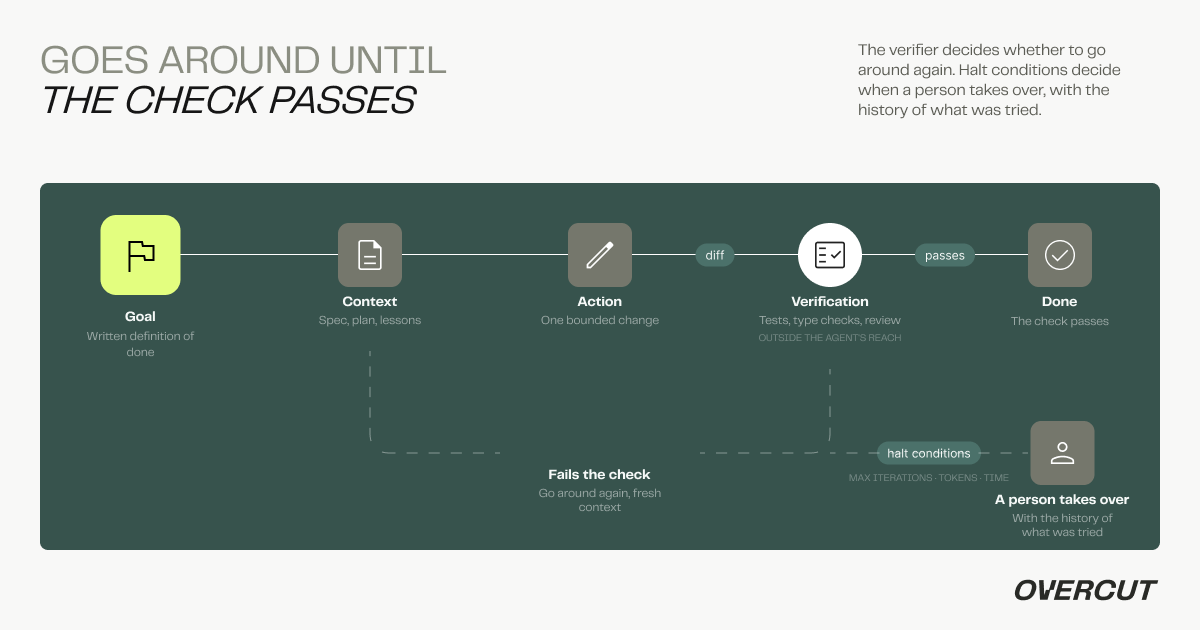
Halt conditions are the part teams skip, because a loop on a laptop already has one: the engineer loses patience and presses Ctrl+C. Once a loop runs on a schedule or a webhook, nobody is watching, and the only limits are the ones written down. In our own PR review loop, any single workflow is capped at three runs, so review, fix, and re-review can never cycle forever.
Why Coding Agents Break Down When Every Team Builds Its Own Loop
The failures at organization scale rarely come from the agent writing bad code. They come from loops that are each right locally and unmanaged as a whole.
Context drifts. Each team writes its own skill files and conventions, and they disagree. One loop knows that every change to the payments service needs a feature flag, another doesn't, and both open pull requests against it. Knowledge that should be shared lives in whichever repository happened to write it down.
Permissions diverge. A loop runs with whatever credentials its author had handy. One uses a personal token with admin rights, another can push straight to main. Nobody decided this at the org level.
Spend has no ceiling. Loops cost money per attempt, failed attempts included. A loop pointed at a much larger codebase than intended, or triggered by a noisy webhook, keeps going until someone notices the bill.
Loops collide. Two teams' loops touch the same shared library, and each treats the other's change as a failure to repair.
Nothing is recorded. When a change causes an incident, nobody can quickly say which loop made it, what it was told, and which checks it passed.
Faster loops can also just move the queue. Eliyahu Goldratt, the management theorist who developed the theory of constraints, made the point in The Goal decades before coding agents existed: speeding up one station does not speed up the factory. If loops open pull requests faster than people can review them, the wait shifts to review. Faros AI saw exactly this in its AI Productivity Paradox Report 2025, where teams with high AI adoption merged 98% more pull requests while review time rose 91%. We wrote about what changes when agents run the whole delivery pipeline in our post on the software factory.
Scaling Loop Engineering With Shared Context and Budgets
One loop for the whole organization would be the wrong fix. Teams know their own domains, and their goals and checks should stay theirs. What should be shared is everything that ought to behave the same no matter whose loop is running.
Shared context comes first: the conventions, ownership, and lessons any agent working in a given service should know, kept in one place that loops read from rather than copied into each repository. Policy comes next. Permissions and approval points belong in the platform the loop runs on, because an instruction in a prompt holds only until the agent misreads it or reads a ticket with injected instructions in it. Then budgets, meaning limits on tokens, runs, and concurrency set where the work is owned, so a runaway loop exhausts its own allowance instead of everyone's. Last, a record of every run: what triggered it, what the agent did, which checks it passed, and what it cost.
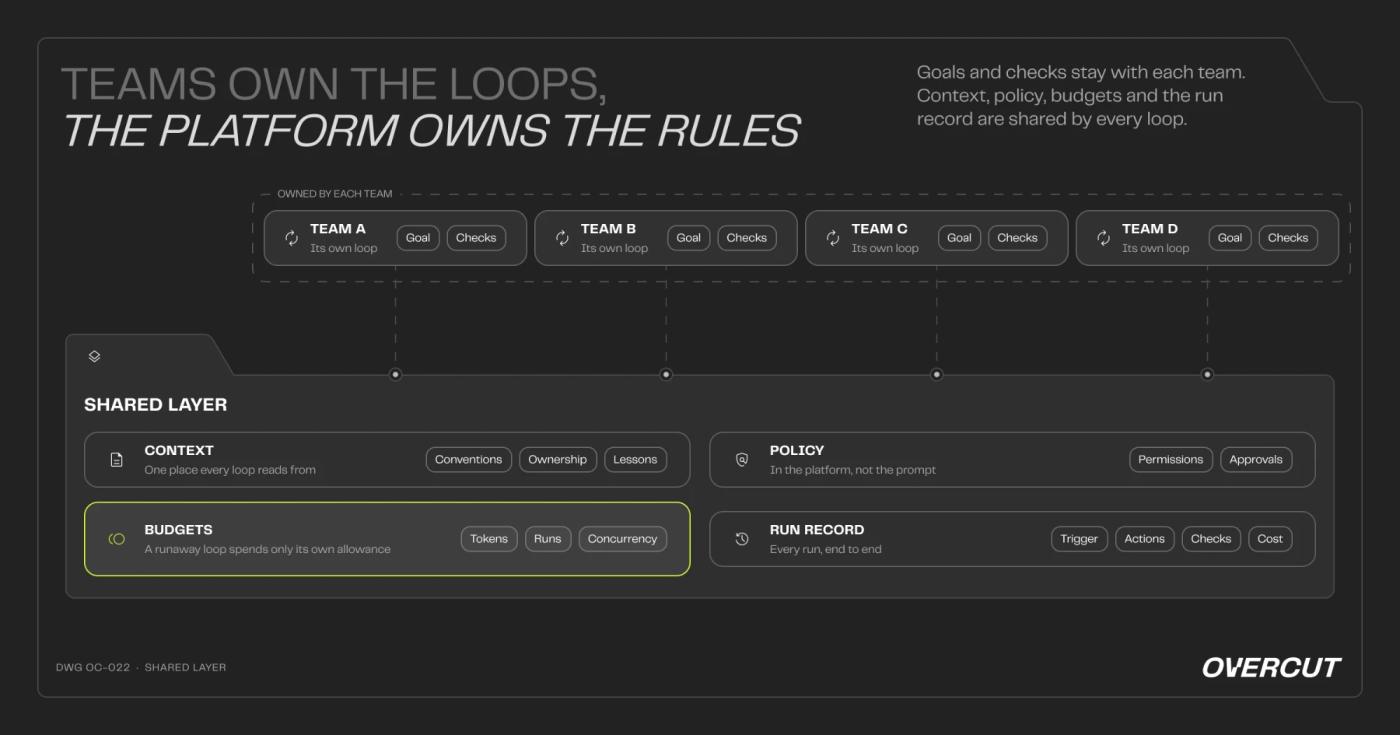
That shared layer is what we build at Overcut. Each loop is a workflow, triggered by events from the git host, tracker, or CI a team already runs, carried out by specialized agents, with a record of every execution. Usage limits cap tokens for a workspace, project, workflow, or connected model, executions for a project or workflow, and parallel runs for a project, and when limits overlap the strictest one applies, so a team can give a new loop a trial allowance without putting the month's budget at risk. Human approval sits where it counts. In our PR review loop, the fix workflow, the only one that rewrites code, waits for a person before it starts. For what these loops look like across delivery, see 6 ways engineering teams are using AI agent orchestration to scale.
Production Feedback Loops That Improve the Next Run
A Ralph loop learns within a task, since each iteration sees what the previous one broke. When the task ends, it forgets. The next run against the same repository rediscovers the same flaky test, the same build quirk, and the same reviewer preference.
An outer loop fixes that. What happens after merge (a revert, an incident traced to a change, a reviewer rejecting the same kind of diff repeatedly, a run that blew through its budget) should change how the next loop starts. Most of it belongs in the loop's context, some in its checks, and occasionally a lesson changes the goal itself.
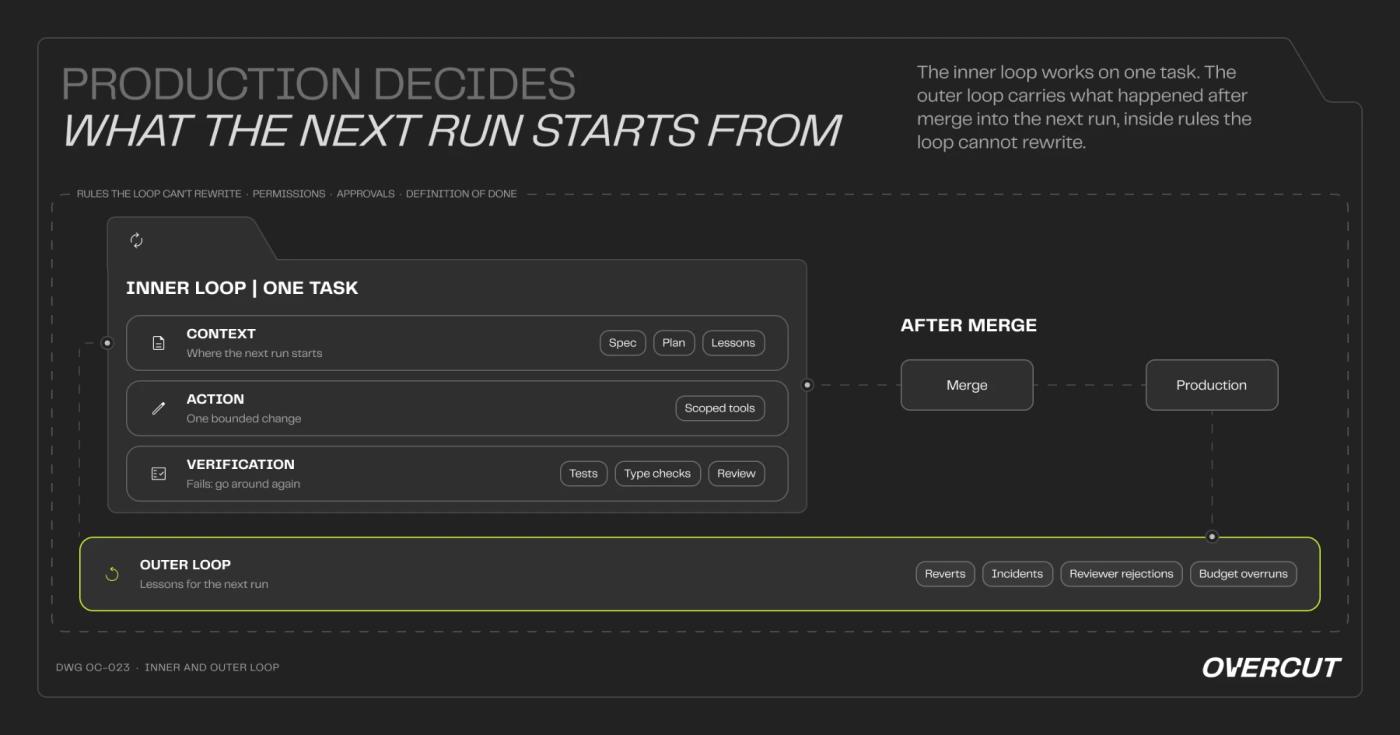
This is where loops need the most restraint, because a loop that edits itself can learn the wrong lesson as easily as the right one. In Overcut's workflow self-improvement, a lesson is scoped to one workflow step and stays tentative until the same pattern shows up on a separate run. Lessons that mislead an agent lose trust faster than helpful ones gain it. A separate retrospective scores the runs, so the agents doing the work never grade themselves. The loop can change how an agent approaches a task, but it cannot change what the agent may do, which approvals it needs, or what counts as done.
Some of this is still open for us. Tracing a production incident back to one iteration of one loop is often an estimate, and we have no reliable automatic way to tell when a lesson went stale after a large refactor. We are confident about the shape, though. Teams own their loops' goals and checks, the platform owns the rules and the record, and production decides what the next run starts from.
FAQs
Is loop engineering the same as prompt engineering?
No. Prompt engineering tunes a single request so the model answers well the first time. Loop engineering assumes the first answer will often be wrong and designs for repeated attempts: the spec the agent reloads, the checks that reject bad output, the state carried between iterations, and the point where it stops. Prompts still matter inside a loop, but they are one part of it.
What is a Ralph loop?
A Ralph loop, named by Geoffrey Huntley after the Simpsons character, runs a coding agent in an endless shell loop that feeds it the same prompt file every time. Each iteration starts with a fresh context window, picks one task from a plan, and relies on tests and type checks to reject bad work. It succeeds when specs and checks are good, and it exposes them quickly when they are not.
Which tasks suit an autonomous coding loop?
Tasks with a mechanical definition of done and strong automated checks: dependency upgrades, framework migrations, fixing failing CI, cleaning up lint and type errors, and adding tests to well-specified code. Loops suit work poorly when success is a judgment call, such as product design, ambiguous bug reports, or architecture choices. A useful test is whether you could write the check before the agent starts.
Do coding loops work with any AI model?
The pattern does, because it only needs an agent that can read files, run commands, and edit code. Results vary by model. Stronger models usually converge in fewer iterations and follow specs more closely, which matters because every iteration costs tokens. Some teams use a cheaper model for generation and a stronger one for review, and set a separate budget for each.
Can loop engineering work for legacy codebases?
Yes, though verification usually needs work first. Legacy systems often lack tests that run fast and fail for real reasons, and a loop trusts whatever its checks report. A practical start is to have a loop write characterization tests that pin down current behavior, review those by hand, and only then let loops make changes against them.