BYO LLM
Every autonomous agent runs on a large language model, and someone has to decide which one. When a platform bundles a model, that decision, along with the bill, the data terms, and the region, belongs to the vendor. BYO LLM moves it back to the organization: the platform keeps supplying the workflows, tooling, and guardrails, and the organization supplies the model through an account, endpoint, or deployment it already owns and has already approved.
Overview
The term borrows from an older pattern. Bring your own device let employees work on hardware the company did not issue, and bring your own key let cloud customers hold the encryption keys to their own data. In both cases the point was control: the service still does the work, but the customer owns the part that matters for policy. BYO LLM applies the same idea to the model behind an AI product. Vendors label it BYOK, BYOM, or BYOLLM, and the labels overlap, but they sit on a ladder of increasing depth: your own key at a provider the platform already supports, your own endpoint that the platform calls, and, in a few hosted runtimes, your own model weights.
In the Agentic SDLC the model is not an implementation detail. Agents read private repositories, tickets, and CI logs, and every prompt travels to whichever endpoint is configured. Engineering leaders therefore want the same things from the model that they already have from their cloud: a provider on the approved vendor list, a region that satisfies residency rules, billing through an existing agreement, and the freedom to change models as quality and price shift. BYO LLM is what makes model choice an organizational control the control plane can enforce, rather than a setting each developer picks in their own editor.
How it works
The organization registers a model once, with its credentials, and the platform routes agent traffic to it. The interesting details are which form of "own" is on offer, how the model reaches every agent, and what responsibilities change hands when it does.
Own key at a supported provider
The platform already integrates a provider such as Azure OpenAI, AWS Bedrock, Anthropic, or OpenAI. You supply your account's credentials and requests run through your tenant, under your contract, billed to you. This is the form most vendors call BYOK.
Own endpoint or gateway
You point the platform at any compatible API by setting a base URL and auth headers. That endpoint can be an LLM gateway such as LiteLLM or Portkey, a proxy behind your API management layer, or a self-hosted model served behind an OpenAI- or Anthropic-compatible interface.
Registered once, assigned everywhere
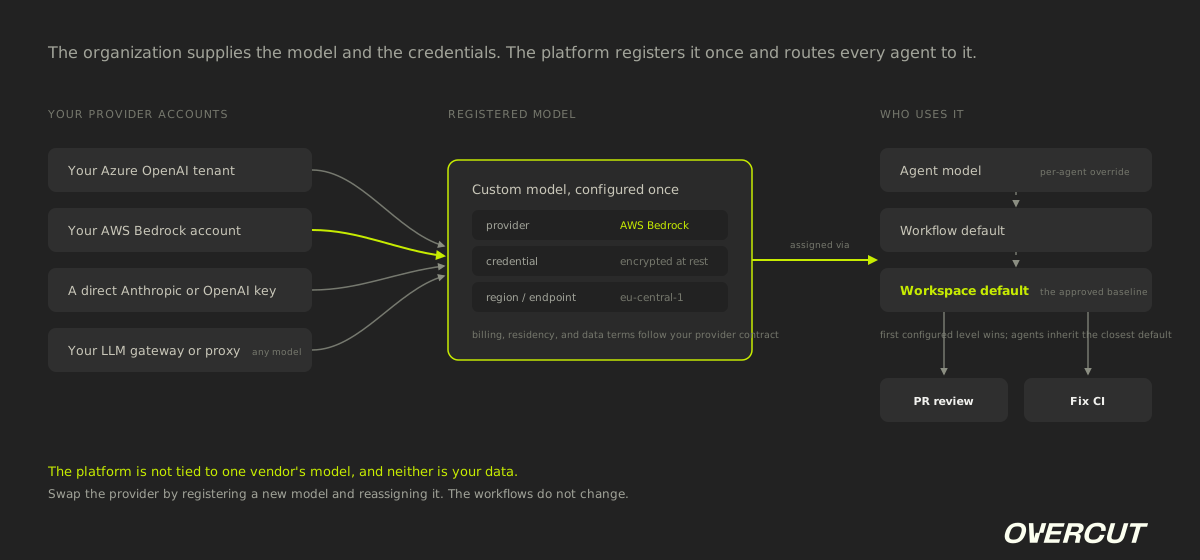
The model is created once at the workspace level, with the key encrypted at rest and the region, deployment, and endpoint recorded. It is then assigned to individual agents, to a workflow, or as the workspace default, and agents inherit the closest configured level.
What moves to you
Billing, rate limits, and provider uptime become your responsibility, and data terms follow your provider agreement rather than the platform's. The model must also meet the floor an agent needs: tool calling, streaming, and a context window large enough for real repositories.
Example in practice
A bank's platform team has an Azure OpenAI deployment in an EU region under the bank's own tenant, already cleared by security and covered by the existing Microsoft agreement. Instead of running Overcut's managed models, the team opens LLM Models, adds an Azure OpenAI model with the tenant's endpoint, deployment name, and key, and sets it as the workspace default. From that point the code review workflow, the ticket triage workflow, and the Fix CI workflow all resolve to that deployment without a single workflow being edited, inference is billed to the bank's Azure subscription, and prompts never leave the bank's tenant. A month later, the team registers an AWS Bedrock model for one workflow that runs on the Claude engine, assigns it at the workflow level, and leaves the workspace default untouched. The audit trail records the model change itself, and usage reporting logs every LLM call against the model that served it, so a compliance reviewer can show which provider processed which run.
What is BYO LLM?
BYO LLM (bring your own LLM) is a platform capability that lets an organization connect its own model provider account, endpoint, or self-hosted model instead of using the vendor's bundled model, so the platform supplies the workflows and tooling while the organization supplies the model and keeps control of billing, data handling, and model choice.
Comparison: BYO LLM vs. the Platform-managed model
The three are complementary rather than competing: a platform-managed model is the fastest start, BYO LLM is how an organization takes ownership of the model decision, and an LLM gateway is often the endpoint that a BYO configuration points at when the organization wants routing, fallbacks, and spend tracking across several providers.
Run agents on the model your organization already trusts
Overcut connects to your Azure OpenAI, AWS Bedrock, Anthropic, or OpenAI account, or to your LLM gateway, and enforces the approved model as the default for every agent.
Get a demo